
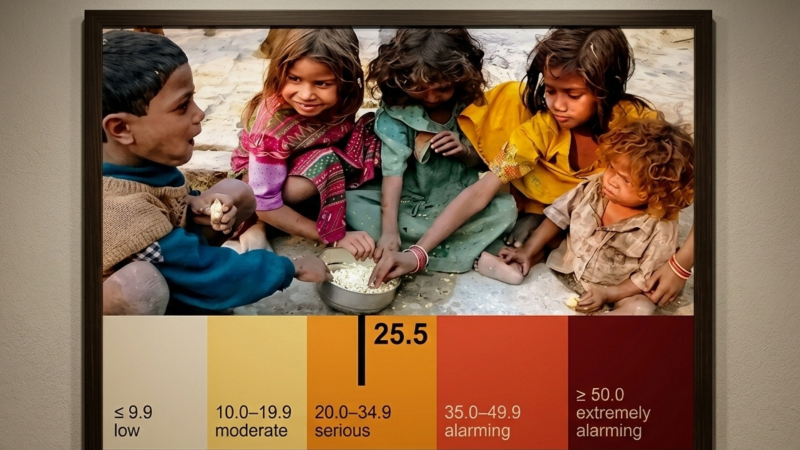
Pakistan has ranked 106th out of 122 countries in the Global Hunger Index (GHI) 2026, with its hunger score rising to 25.5 from a recalculated 24.0 in 2018, highlighting persistent challenges in food security, child nutrition and public health. The report, released on October 14, classifies Pakistan’s hunger level as “serious”. The findings place the country among those experiencing deteriorating hunger conditions despite progress over the longer term.
According to the report, 16.1 per cent of Pakistan’s population is undernourished, while 33.6 per cent of children under five experience stunted growth. A further 9.8 per cent of children in the same age group suffer from wasting, and the under-five mortality rate stands at 5.6 per cent. These indicators demonstrate that the country’s hunger challenge extends beyond the availability of food to include the affordability, nutritional quality and accessibility of meals, particularly for vulnerable households.
Pakistan also recorded the highest hunger score in South Asia. Afghanistan ranked 108th globally, with a score of 28.6, while India stood at 100th with 24.1. Bangladesh ranked 84th with 19.2, Nepal 72nd with 14.5, and Sri Lanka 53rd with 10.2.
The findings come amid continuing economic pressures that have weakened household purchasing power and made nutritious food increasingly difficult for low-income families to afford. Climate-related disruptions, including floods and crop losses, have added pressure on agricultural production and rural livelihoods. These challenges are compounded by poverty, unequal access to healthcare and inadequate maternal and child nutrition services.
The 2026 report, published under the theme “No Security Without Food Security”, also warns of a broader reversal in global efforts to combat hunger. Conflict, climate shocks and economic uncertainty are undermining progress towards the United Nations Sustainable Development Goal of ending hunger by 2030.
For Pakistan, the latest figures underscore the need for sustained investment in nutrition programmes, maternal healthcare, social protection and climate-resilient agriculture. Strengthening food distribution systems and improving access to affordable, nutritious food will also be essential to protect vulnerable communities.
While the country has achieved long-term improvements, the latest deterioration raises questions about the sustainability of those gains. Addressing hunger will require coordinated policies that tackle both immediate food insecurity and its underlying economic and social causes.