
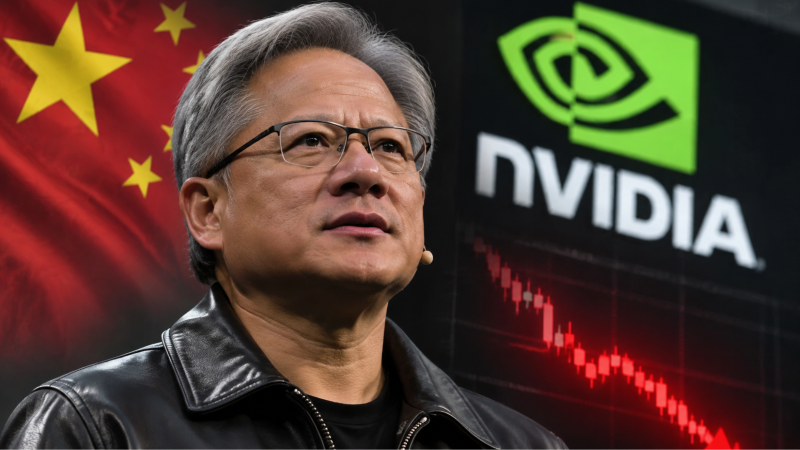
Nvidia, the world's most valuable artificial intelligence chipmaker, is facing an escalating corporate and national security crisis after allegations surrounding its chief executive, Jensen Huang, triggered a dramatic sell-off in its shares and renewed scrutiny of the company's business dealings with China.
The controversy, involving an alleged Chinese intelligence operation, a reported relationship between Huang and a Chinese businesswoman, and suspected diversion of restricted semiconductor shipments, has wiped approximately $430 billion off Nvidia's market value. The episode has transformed what initially appeared to be a private matter into a broader test of corporate accountability and Washington's ability to protect strategically sensitive technology.
At the centre of the allegations is Alice Huang, a Chinese businesswoman reportedly suspected by US intelligence of having links to Beijing's Ministry of State Security. Reports suggest that her relationship with Nvidia's 63-year-old chief executive may have exposed the company to a potential foreign intelligence operation. Huang has acknowledged being unfaithful to his wife, while the FBI is examining whether he was deliberately targeted. There is, however, no established evidence that he knowingly assisted a foreign intelligence operation.
The implications extend well beyond the personal conduct of Nvidia's chief executive. Reports indicate that Alice Huang's business network helped facilitate the movement of approximately 240,000 Nvidia chips, including H100, H200 and A100 processors, worth at least $7.5 billion, into China. Some of the hardware reportedly reached companies and artificial intelligence laboratories, including Alibaba and Tencent, despite US restrictions on exports of advanced semiconductors.
Singapore has emerged as an important part of the investigation. Megaspeed International, a Singapore-based cloud computing company associated with Alice Huang, reportedly acquired substantial quantities of Nvidia equipment through commercial networks. US authorities are examining suspected chip diversion, while the company has denied wrongdoing and maintained that investigations have found no evidence of illegal transfers.
The political fallout is equally significant. President Donald Trump has said he believes Huang did not know the woman was allegedly connected to Chinese intelligence. However, reports that Secretary of State Marco Rubio briefed Trump on intelligence concerning the relationship have prompted questions about when the administration became aware of the potential security implications.
President Trump: "I spoke to @JensenHuang today. He told me he had no idea that women was a spy, and I really believe him" https://t.co/jHY8r0Dhl7
— Commentary Donald J. Trump Truth Social Posts On X (@TrumpTruthOnX) November 9, 2026
Democratic Senate Minority Leader Chuck Schumer has demanded greater transparency and tighter restrictions on advanced chip exports to China. Lawmakers are also pressing for legislation that would strengthen chip-tracking requirements and give Congress greater oversight of sensitive technology transfers.
For Nvidia, the immediate financial damage may be only the beginning. The company has become central to the global AI economy, making its leadership, governance and supply-chain integrity matters of strategic importance. Its extraordinary dependence on Huang, who has led the company for more than three decades, has also raised questions about succession planning and the board's ability to exercise independent oversight.