
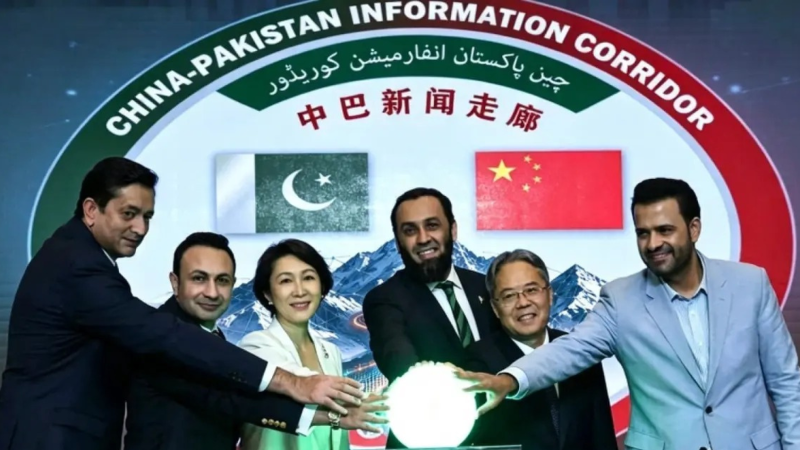
Pakistan and China have launched the China-Pakistan Information Corridor (CPIC), a four-pillar initiative aimed at countering misleading narratives, strengthening media cooperation, promoting bilateral trade and expanding cultural exchanges between the two countries. The corridor was formally launched in Islamabad on Tuesday at a ceremony attended by Federal Minister for Information and Broadcasting Attaullah Tarar, Chinese Ambassador to Pakistan Jiang Zaidong and Chinese Foreign Ministry Spokesperson Mao Ning.
The initiative seeks to extend bilateral cooperation beyond infrastructure and economic development by connecting people through verified information, digital platforms, research and cultural engagement. Addressing the ceremony, Tarar said the China-Pakistan Economic Corridor (CPEC) had strengthened physical connectivity between the two countries, while the new initiative would focus on building mutual understanding digitally. He described CPIC as a bridge between the people of Pakistan and China, emphasising that information sharing and people-to-people exchanges were essential to sustain their longstanding relationship.
Under the media component, an 18-member news exchange working group comprising Pakistani and Chinese media organisations will facilitate the sharing of verified information about bilateral cooperation. Participating organisations include Chinese outlets such as Xinhua News Agency, China Media Group and People's Daily, alongside Pakistani media institutions. A dedicated fact-checking mechanism will also help identify misleading narratives and respond to misinformation through verified information, according to officials.
The business and enterprise pillar aims to strengthen trade and investment links. Tarar said the initiative's first regional office had been established in Karachi, while a dedicated online portal was being developed to track bilateral trade, investment and foreign direct investment. A podcast series is also planned to highlight the experiences of Chinese entrepreneurs operating in Pakistan and Pakistani businesspeople working in China.
The think-tank component, led by the Pakistan-China Institute and involving research institutions from both countries, will promote joint research, policy dialogue and publications to deepen understanding of bilateral relations. The fourth pillar will focus on culture, tourism and youth engagement. Work is underway on a tourism corridor linking China's Xinjiang region with Gilgit-Baltistan to encourage travel and strengthen cultural connections.
Tarar also announced that the first cohort of CPEC youth ambassadors had been nominated from 13 universities across Pakistan, providing young people with opportunities to participate in engagement initiatives. Mao Ning highlighted the growing challenges posed by fake news and misinformation, stressing the importance of accurate, timely and reliable information. Ambassador Jiang Zaidong also welcomed the initiative, saying greater information sharing could improve understanding of the two countries' cultures and traditions.
The launch comes as Pakistan and China mark 75 years of diplomatic relations. By bringing journalists, researchers, businesses, universities and young people into a shared framework, CPIC aims to reinforce bilateral ties while promoting more informed public discussion about cooperation between the two countries.