
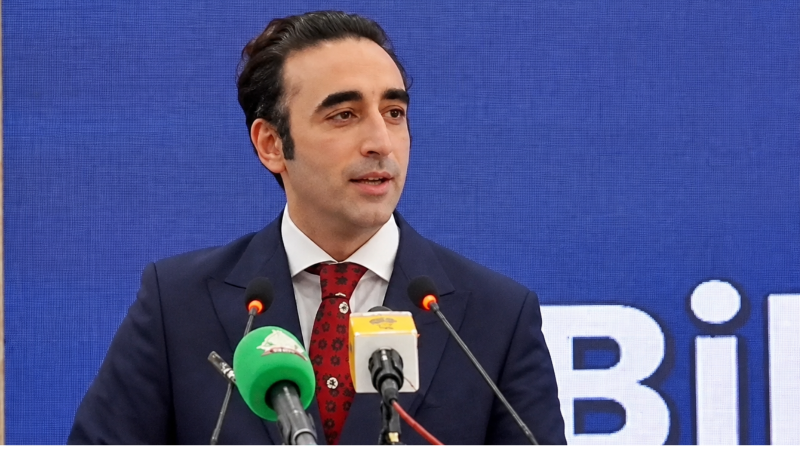
Pakistan Peoples Party (PPP) Chairman Bilawal Bhutto-Zardari has called for a political reset of the country's governance system, arguing that its institutional failures were not inevitable but deliberately engineered, as debate over administrative restructuring and the creation of new provinces intensifies.
Speaking at the Karachi Press Club on Tuesday, Bilawal rejected the assertion that Pakistan's governance system had simply collapsed, insisting that it had been “made to collapse”. His remarks offered a pointed challenge to the growing narrative that administrative restructuring alone could resolve the country's deep-rooted governance crisis.
The debate over a proposed “system reset” has gained momentum in recent months following Interior Minister Mohsin Naqvi's calls for establishing new administrative units. Naqvi had argued that the existing governance structure had collapsed and required a fundamental overhaul, triggering political controversy over whether Pakistan's administrative boundaries and provincial arrangements should be revisited.
لائیو: چیئرمین پاکستان پیپلز پارٹی بلاول بھٹو زرداری کراچی پریس کلب آباد میں میٹ دی پریس سے خطاب کررہے ہیں۔ https://t.co/odYx92OC6h
— PPP (@MediaCellPPP) November 17, 2026
While acknowledging that a reset was necessary, Bilawal sought to shift the discussion away from administrative engineering towards political responsibility. “Why political? Because politicians are the representatives of the people, and if politicians do not play their role, then these fundamental issues won’t be resolved,” he said.
The PPP chairman's intervention comes amid renewed scrutiny of Pakistan's federal structure, where persistent governance failures, uneven development, weak local government institutions and political centralisation have fuelled demands for administrative reform. However, the debate also raises a fundamental question: whether creating additional administrative units would address structural inequalities or merely redistribute authority without challenging the political arrangements that sustain them.
Bilawal's emphasis on political ownership also places responsibility on the political class itself. While rejecting the notion of an inherently failed system, his argument leaves little room for politicians to evade accountability for governance failures under successive elected governments.
Bilawal also defended Jamiat Ulema-i-Islam-Fazl (JUI-F) chief Maulana Fazlur Rehman as tensions between the religious-political leader and the government have escalated in recent weeks. His remarks signal the PPP's continued engagement with opposition political forces at a time when disagreements over governance and the country's political direction are becoming increasingly pronounced.
The broader challenge, however, remains whether Pakistan's political leadership can translate calls for a democratic reset into institutional reforms that strengthen accountability, provincial autonomy and public representation rather than reproduce the same power structures under a different administrative arrangement.