
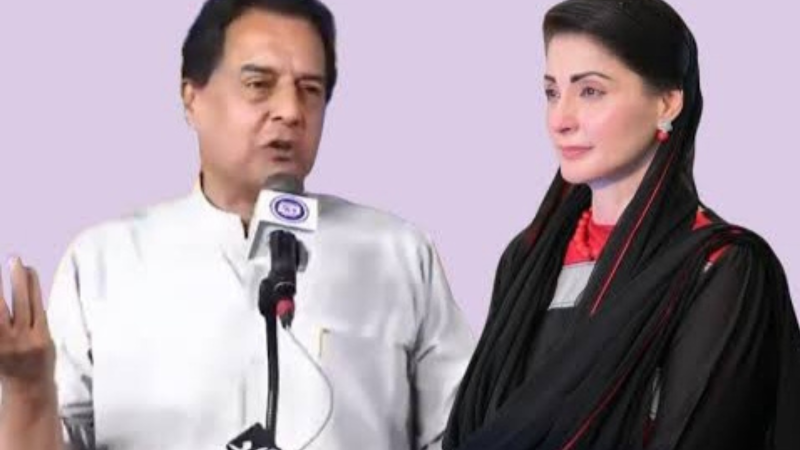
Captain (retd) Muhammad Safdar faces mounting criticism for mocking women battling cancer while ridiculing the feminist slogan ‘Mera Jism Meri Marzi’, prompting his wife, Punjab Chief Minister Maryam Nawaz, to publicly distance herself from his remarks.
Captain (retd) Muhammad Safdar has come under intense public criticism after making sarcastic remarks about women battling cancer during a speech in Chiniot, triggering widespread condemnation over the insensitivity of his comments. Safdar sparked controversy after targeting the feminist slogan ‘Mera Jism Meri Marzi’ (My Body, My Choice), suggesting that women who assert ownership over their bodies should also be capable of curing themselves when diagnosed with cancer.
“They say, ‘My body, my choice.’ But when they fall ill or develop cancer, they turn to religious scholars, seeking prayers and blessed water for a cure. They should understand that if they claim ownership over their bodies, they should also be able to cure them. In reality, the human body is under God's control,” he remarked. The comments drew sharp criticism on social media, with many questioning how a public figure could turn a potentially life-threatening illness into an instrument of political and ideological mockery. Critics also highlighted the distinction between advocating bodily autonomy and claiming control over biological processes, arguing that Safdar's comparison was both logically flawed and deeply insensitive towards cancer patients.
Heartbreaking. The silent battles a woman, a wife, fights behind closed doors… The strength she must find even when she feels like breaking. Some battles are fought in silence, and some wounds are invisible.
— Maryam Nawaz Sharif (@MaryamNSharif) October 30, 2026
The controversy became particularly uncomfortable given the family's own experience with the disease. Safdar's mother-in-law, Begum Kulsoom Nawaz, died in September 2018 following a months-long battle with cancer. Responding to a post on X, highlighting the irony of Safdar mocking women with cancer despite having lost his mother-in-law to the disease, the Punjab chief minister expressed her disapproval through a broken-heart emoji.
Maryam subsequently described the situation as “heartbreaking”, drawing attention to the silent and often invisible struggles that women endure, particularly within their families and marriages. Her response was significant not merely because of her position as Punjab's chief executive but also because it offered a rare public indication of disagreement with her husband's controversial remarks. Rather than defending the statement or dismissing the criticism, her reaction appeared to acknowledge the emotional harm caused by turning women's suffering into a subject of ridicule.
The controversy also widened after two leading lawyers condemned Safdar's remarks about late human rights lawyer and senior lawyer Asma Jahangir, whom he had reportedly called “cursed” during the Chiniot gathering. The Pakistan Bar Council and the executive committee of the Supreme Court Bar Association criticised the language used against the deceased activist, describing it as disrespectful and unacceptable. They urged public representatives to exercise restraint, uphold dignity in their statements and avoid personal attacks, religious intolerance and character assassination. The Supreme Court Bar Association (SCBA) also called on the relevant authorities to take notice, warning that such statements could carry legal consequences.
The argument that women should be able to cure themselves of cancer if they claim ownership over their bodies also overlooks a fundamental distinction: bodily autonomy does not mean immunity from illness or the ability to control medical outcomes. For a society where cancer patients and their families already confront enormous physical, financial and emotional challenges, turning their suffering into a political punchline is difficult to justify.