
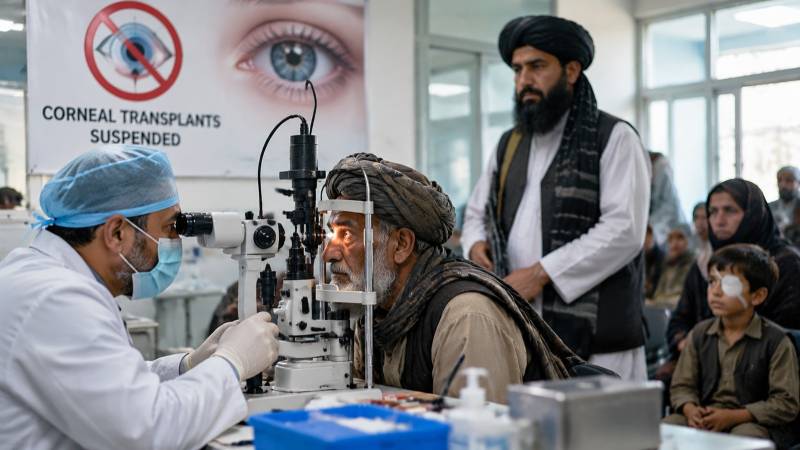
Taliban authorities have reportedly ordered hospitals in Afghanistan to stop performing corneal transplant operations, citing religious objections to the sight-restoring procedure and leaving hundreds of patients uncertain about accessing potentially life-changing treatment. The reported restrictions have raised concerns about the availability of specialised eye care in a country whose healthcare system has been weakened by decades of conflict.
Dr Noor Zaman Hashim of Noor Eye Hospital in Kabul said his team had performed around 90 corneal transplants in recent months before the programme was suspended following verbal instructions attributed to Taliban authorities. According to the doctor, the hospital's waiting list includes many young patients who lost their eyesight in explosions, workplace accidents and other traumatic incidents. He said medical staff were reluctant to challenge the directive because they feared possible punishment.
Corneal transplantation involves replacing damaged or scarred tissue at the front of the eye with healthy donor tissue. For suitable patients, the procedure can significantly improve vision or restore sight, depending on the extent of the injury and the condition of other parts of the eye. The reported suspension has also affected a programme supported by the Association of Physicians of Pakistani Descent of North America (APPNA), which expanded its free corneal transplant initiative from Pakistan to Afghanistan earlier this year.
The organisation has facilitated more than 150 transplant operations in Afghanistan, while three Afghan ophthalmologists received training in Peshawar to help provide the specialised treatment locally. Dr Fawad Zaffar, who leads APPNA's cornea programme, said the expansion had been intended to address substantial unmet medical needs. The organisation has provided donated corneas for free treatment in Pakistan since 2017, helping thousands of patients access procedures they might otherwise be unable to afford. The suspension has left patients who had registered for surgery facing uncertainty over when, or whether, their operations will resume.
The controversy also highlights questions surrounding the distinction between commercial organ trade and medically supervised transplantation using donated tissue. The Taliban had previously announced restrictions on the buying and selling of human organs. However, the scope of those restrictions in relation to donated corneas used for medical treatment remains unclear. APPNA has urged the Taliban authorities to permit the procedures to resume, warning that the interruption threatens access to essential treatment for vulnerable patients.