
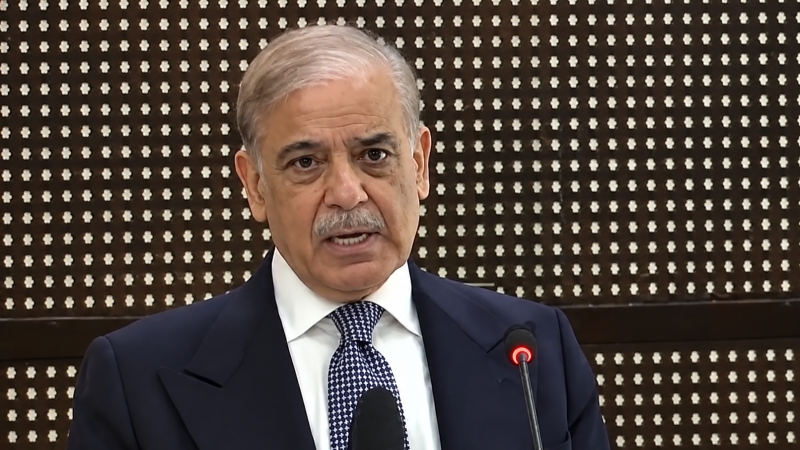
Prime Minister Shehbaz Sharif on Thursday credited what he described as a “productive partnership between the military and the political hierarchy” for Pakistan’s recent economic achievements, placing institutional cooperation at the centre of the government’s narrative of economic recovery.
Addressing a ceremony organised by the American Business Council of Pakistan, the prime minister said the government had taken “difficult decisions, exercised fiscal discipline and embarked upon a programme of structural reforms” to stabilise the economy. He argued that national development required teamwork, flexibility, sincerity and hard work, alongside a willingness to place national interests above personal preferences.
The prime minister’s emphasis on civil-military cooperation comes as the government continues to present economic stabilisation as evidence of its policy direction. However, the durability of these gains will depend on whether macroeconomic improvements translate into investment, industrial expansion, employment generation and relief for ordinary citizens.
“Our task now is to consolidate these gains and put Pakistan firmly on the path of sustained export-led growth,” Shehbaz said, acknowledging that stabilisation alone was insufficient to secure long-term economic prosperity.
Addressing a ceremony hosted by the American Business Council, Prime Minister Shehbaz Sharif says the civil and military leadership are working in close coordination and harmony to steer Pakistan towards stability, progress and prosperity. @CMShehbaz #PMShehbazSharif #CivilMilitaryCoordination #PakistanDevelopment #NationalStability #PakistanTV
— Pakistan TV (@PakTVGlobal) November 19, 2026
He also sought to address concerns surrounding Pakistan’s investment climate, announcing that the government would establish a mechanism to resolve genuine complaints from investors and remove obstacles affecting businesses. He acknowledged that bureaucratic inefficiencies and procedural delays frequently persisted for years, discouraging both domestic and foreign investors.
The commitment to streamline administrative procedures reflects a longstanding challenge for Pakistan’s business environment, where policy uncertainty, regulatory complications and institutional delays have often undermined investor confidence. Whether the proposed mechanism can deliver meaningful improvements will depend on its authority, implementation and ability to hold relevant departments accountable.
Recalling the economic crisis of 2023, when Pakistan faced the threat of sovereign default, Shehbaz maintained that the country had since achieved macroeconomic stability and sustained relatively steady conditions despite the continuing Gulf crisis.
He pointed to Pakistan’s heavy dependence on imported energy, noting that the country imports more than 90 per cent of its energy requirements. Despite this vulnerability and regional instability, he said, the country had avoided fuel station queues and widespread public panic, attributing the situation partly to the government's Prime Minister's Fuel Relief Scheme.
Yet, the transition from stabilisation to sustained growth will require more than political and institutional coordination. Consistent economic policies, competitive exports, energy-sector reforms, reduced regulatory barriers and a predictable investment environment will be critical to determining whether the government's economic recovery narrative translates into lasting gains.