
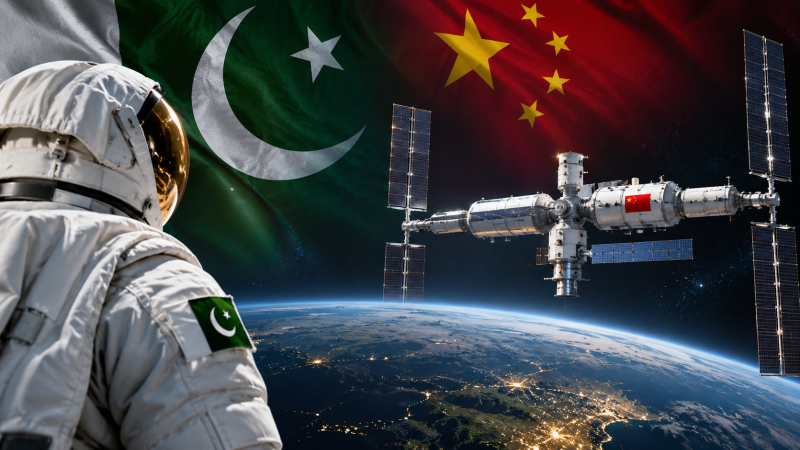
Pakistan is set to make history by sending its first astronaut to China’s Tiangong space station aboard the Shenzhou-24 mission, becoming the first foreign country to have a national participate in China’s crewed space programme. The China Manned Space Agency (CMSA) announced the development on Saturday, confirming that a Pakistani astronaut would join the Shenzhou-24 crew as a payload specialist. However, Chinese authorities have yet to disclose the astronaut’s identity or announce an official launch date. The mission is expected to take place before the end of 2026.
The announcement follows a February 2025 cooperation agreement between Pakistan and China aimed at selecting and training Pakistani astronauts for missions to the Chinese space station. Two Pakistani candidates, Muhammad Zeeshan Ali and Khurram Daud, have undergone months of training at the China Astronaut Research and Training Centre in Beijing. According to the CMSA, the selected astronaut will undertake a short-duration orbital mission before returning to Earth aboard the Shenzhou-23 spacecraft. The arrangement represents the first joint spaceflight involving Chinese and foreign astronauts in China's crewed space programme.
While the development represents a significant milestone for Pakistan's scientific and technological ambitions, it also exposes the country's continued reliance on foreign infrastructure to access human spaceflight. Pakistan does not possess an independent crewed space programme, and its participation in the mission depends on Chinese spacecraft, launch facilities, training and technical expertise. The partnership therefore raises a broader question: whether Pakistan can translate diplomatic cooperation and symbolic achievements into sustainable domestic scientific capacity..
However, the long-term value of the achievement will depend on whether the country invests in its own research institutions, engineering capabilities and scientific workforce rather than treating participation in foreign missions as an end in itself. The Shenzhou-24 mission may put a Pakistani astronaut in orbit, but building an independent and sustainable space programme will require considerably more than international agreements and ceremonial announcements.