
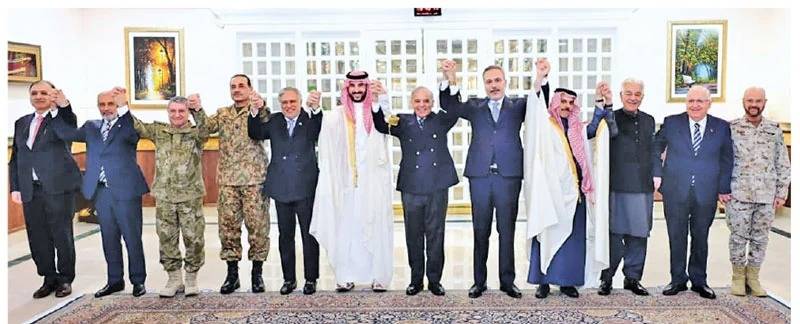
ISLAMABAD: Pakistan, Saudi Arabia and Turkiye reaffirmed their commitment to collective defence under the Makkah Alliance for Defence, strongly condemning continued Houthi attacks against Saudi Arabia and pledging to intensify cooperation to safeguard the kingdom’s security, sovereignty and territorial integrity.
The commitment was made during the second meeting of the high-powered Strategic Political and Defence Committee (SPDC) of the Makkah Alliance for Defence, held in Islamabad, where the three countries expressed solidarity with Saudi Arabia over attacks targeting civilians and civilian infrastructure.
The meeting brought together senior political, diplomatic and military leadership from all three countries to review the evolving regional security environment and strengthen their collective response to emerging threats.
Deputy Prime Minister and Foreign Minister Ishaq Dar, Defence Minister Khawaja Muhammad Asif, and Chief of Defence Forces and Chief of Army Staff Field Marshal Syed Asim Munir represented Pakistan.
The Saudi delegation was led by Defence Minister Prince Khalid bin Salman bin Abdulaziz Al Saud and included Foreign Minister Prince Faisal bin Farhan Al-Saud and Chief of the General Staff General Fayyadh bin Hamed Al-Ruwaili.
Turkiye was represented by Foreign Minister Hakan Fidan, National Defence Minister Yasar Guler and Chief of the General Staff General Selçuk Bayraktaroglu.
During the discussions, the three sides reiterated their commitment to collective defence, mutual solidarity and respect for the sovereignty and territorial integrity of all member states. They also condemned attacks on Saudi civilians and civilian infrastructure, underscoring the need for coordinated efforts to address security threats confronting the kingdom.
Pakistan and Turkiye pledged to accelerate their efforts to support Saudi Arabia's security and territorial integrity, reinforcing the alliance's emphasis on shared responsibility and strategic cooperation.
Beyond the immediate security concerns, the meeting focused on translating the alliance's political commitments into practical institutional and operational arrangements.
The member states are working towards operationalising the alliance's permanent General Secretariat in Riyadh, which is being led by its first Secretary-General, retired Lieutenant General Nauman Mahmood.
The committee also reviewed progress on developing standard operating procedures (SOPs), establishing rapid-deployment mechanisms and strengthening coordination among the participating countries.
Other priority areas include joint technical development, military training, capacity-building and cooperation between defence industries. These initiatives are intended to improve operational coordination, strengthen institutional capabilities and provide a framework for sustained defence collaboration.
The establishment of rapid-deployment mechanisms and common operational procedures is particularly significant as the alliance seeks to move beyond diplomatic declarations towards more structured security cooperation.
The Islamabad meeting comes amid continuing regional instability and heightened concerns over threats to Saudi security and civilian infrastructure. By reaffirming their collective defence commitment, Pakistan, Saudi Arabia and Türkiye have signalled their intention to deepen strategic coordination and present a more unified response to emerging regional challenges.
The meeting's focus on institutional development and defence cooperation also reflects an effort to give the Makkah Alliance a permanent operational structure, with Riyadh serving as its administrative centre.
The three countries reiterated that their partnership would be guided by mutual solidarity, respect for sovereignty and a shared commitment to regional security.