
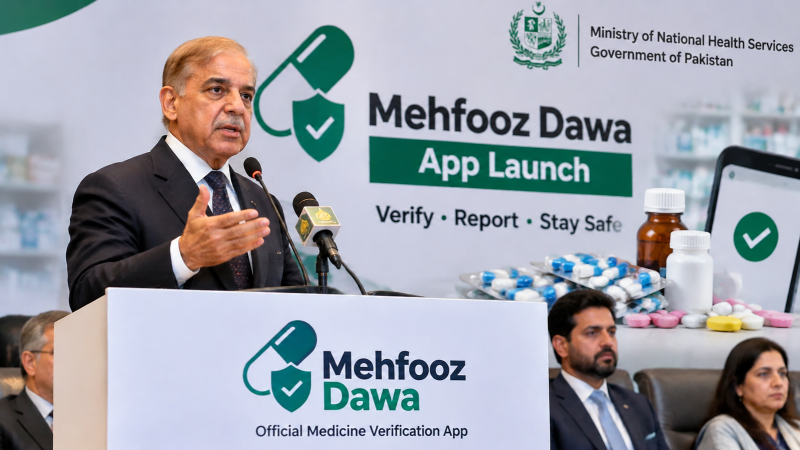
Prime Minister Shehbaz Sharif on Thursday launched the “Mehfooz Dawa” mobile application, a government initiative aimed at curbing the circulation of counterfeit and substandard medicines, strengthening regulatory oversight and restoring public confidence in Pakistan’s healthcare system.
Addressing the launch ceremony organised by the Ministry of National Health Services, the prime minister described the application as a “major milestone” for the country’s healthcare sector, saying it would help protect patients from potentially dangerous medicines. Shehbaz termed the initiative an “extremely magnificent moment” for Pakistan’s medical facilities, emphasising the need to learn from past failures and strengthen safeguards to prevent similar tragedies.
Prime Minister Muhammad Shehbaz Sharif launches the Mehfooz Dawa digital application for track and trace of medicines, in Islamabad, today. #MehfoozDawaMuhafiz https://t.co/eCvj9tGeog
— Prime Minister's Office (@PakPMO) November 26, 2026
Recalling the 2012 Punjab Institute of Cardiology (PIC) drug contamination scandal, he said counterfeit medication had been blamed for the deaths of more than 100 patients. At the time, the Drug Regulatory Authority of Pakistan (DRAP) had maintained that the medicine was genuine, but subsequent international testing found that the medication administered to patients was intended for malaria treatment.
The incident exposed serious weaknesses in the country's drug regulation and quality-control mechanisms, highlighting the consequences of inadequate oversight in the pharmaceutical sector.
“Learning from the past and preparing ourselves” was essential to prevent such incidents in the future, the prime minister said, underscoring the importance of technological solutions in strengthening public health protections.
He praised Federal Minister for National Health Services Mustafa Kamal for his efforts in developing the application and directed the ministry to coordinate with the Information Technology and Information ministries to launch a comprehensive public awareness campaign.
“History will remember this step in golden words,” Shehbaz remarked.
Speaking at the ceremony, Kamal said the application had been developed with the primary objective of “protecting innocent lives”, acknowledging that public confidence in the safety and authenticity of medicines remained a significant concern.
He highlighted the pharmaceutical industry's cooperation in developing a comprehensive database of approximately 92,000 medicines involving more than 700 pharmaceutical companies, describing the process as an “uphill task”.
DRAP Chief Executive Officer Dr Obaidullah said the application was designed to address three major challenges confronting the pharmaceutical sector: counterfeit medicines, drug shortages and quality compliance.
The application offers three primary features: medicine verification, complaints registration and shortage reporting. Consumers can verify the authenticity of medicines by scanning the batch number printed on the packaging. The application checks the information against DRAP's database, displaying a green screen if the medicine is verified as genuine and a red screen if it is identified as counterfeit.
Users can also lodge complaints directly through the application if they encounter suspected counterfeit products. Additionally, the shortage-reporting feature allows citizens to notify authorities about the unavailability of essential medicines.
The initiative introduces a technology-based mechanism for involving consumers in drug monitoring, although its effectiveness will ultimately depend on public awareness, accurate database management and timely regulatory action against violations.
By placing medicine verification and reporting tools directly in consumers' hands, the government hopes to strengthen accountability across the pharmaceutical supply chain and address longstanding concerns about drug safety.