
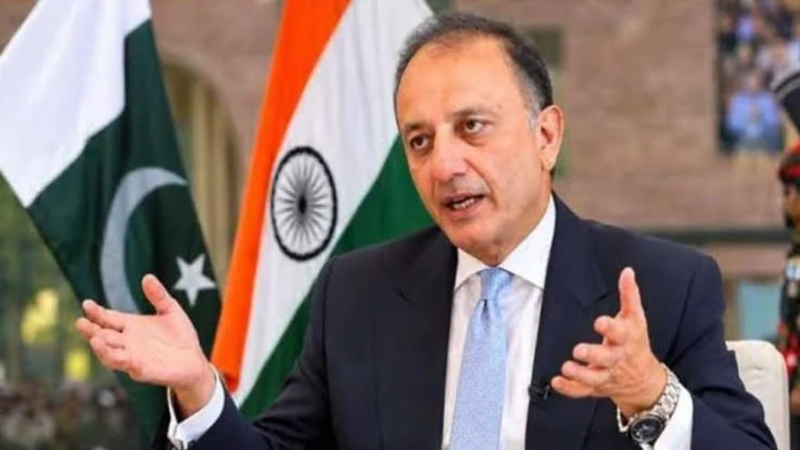
Pakistan’s Climate Change Minister Musadik Masood Malik has expressed optimism about improving relations with India, describing the rapidly shifting geopolitical landscape as an opportunity for regional countries to adopt a broader approach to political, social and diplomatic challenges.
Speaking to reporters in New Delhi, on the sidelines of the inaugural Shanghai Cooperation Organisation (SCO) Civilisational Dialogue Forum, Malik said he was hopeful that regional relationships would improve through greater engagement and a collective understanding of shared challenges.
Asked whether India-Pakistan relations could improve following the forum, Malik said, “I think all of our relationships will improve. The region is in flux, as you know. The plates underneath geopolitics are shifting very fast.” He emphasised the need to look beyond individual political disagreements and adopt a broader regional perspective, adding that countries should address political and social issues while advancing a common regional agenda.
#WATCH | Delhi: On being asked if India-Pakistan relations will improve after the First Shanghai Cooperation Organisation (SCO) Civilisational Dialogue Forum, Pakistan Minister Musadik Masood Malik says, "I think all of our relationships will improve. The region is in flux, as you know. The plates underneath geopolitics are shifting very fast. I'm very hopeful that we will take a macro view, and in that macro view, we'll be looking at all of the political issues, all of the social issues, all of the issues of conversation, and we'll be pushing the agenda of the region."
— ANI (@ANI) November 20, 2026
Malik said he hoped participating nations would take a “macro view” of the challenges confronting the region, stressing that dialogue should extend beyond immediate political differences to encompass broader questions of cooperation and shared interests.
Leading Pakistan’s delegation at the three-day forum, scheduled from November 20 to 22, Malik described the gathering as a “tremendous opportunity” for multilateral engagement. He highlighted the importance of shared history, culture and civilisation as foundations for dialogue among regional countries.
His remarks come against the backdrop of strained India-Pakistan relations following the military confrontation between the two nuclear-armed neighbours in May 2025. The minister’s visit marks the first by a Pakistani federal minister to India since that confrontation, making his participation diplomatically significant.
#WATCH | Delhi: "Mujhe ummeed hai ki dobara aap gila nahi karenge aur hamara aana jaana rahega..." says Pakistan Minister Musadik Masood Malik as he participated in the first SCO Civilisational Dialogue Forum in Delhi https://t.co/JWHvUlkZwV
— ANI (@ANI) November 20, 2026
Malik recalled the August 26 floods in Nepal, which claimed more than 1,400 lives and left thousands missing, as well as Pakistan’s devastating 2022 monsoon floods. He noted that the floods killed approximately 1,700 people and submerged nearly one-third of the country, including almost the entirety of Sindh.
“Four days of rain caused the walls of Mohenjo Daro to collapse; walls that no one had been able to breach for 4,500 years were brought down by climate change and rain-induced flooding,” he said.
Switching from English to Urdu during his address, Malik invoked the poetry of Mirza Ghalib and highlighted the shared linguistic and cultural heritage of Delhi, Lucknow and Lahore. He also underscored the region’s diverse historical legacy, encompassing the Indus Valley and Gandhara civilisations, arguing that Pakistan regarded this heritage as a shared inheritance of humanity rather than something to be guarded in isolation.
"بڑا عجیب سا لگا کہ چند کوس دور غالب کے مقبرے سے یہاں بیٹھ کر میں انگریزی میں بات کر رہا ہوں۔" وفاقی وزیر ڈاکٹر مصدق ملک کا نئی دہلی میں پہلے ایس سی او سولائزیشن ڈائیلاگ فورم سے اہم خطاب https://t.co/1w6AVWsC3U
— Senator Musadik Office (@Team_Musadik) November 21, 2026
His address centred on climate change as an escalating threat to shared cultural heritage and underscored the importance of regional dialogue and cooperation in confronting common challenges.
Recalling the humanitarian response to the floods, Malik said people had sought shelter wherever they could find it, including parking lots and shopping malls. Mosques, temples, shrines and schools in Balochistan had also opened their doors to those displaced by the floods.
“This is the power of civilisation. This is the power through which nations survive,” the minister said.
Highlighting Pakistan’s historical evolution, Malik observed that its civilisation had been shaped by multiple cultural influences, with historical connections extending across China, Central Asia, Iran and the Middle East.
“When we look at our history, all our roads lead to the north: Bukhara, Samarkand, Central Asia and Afghanistan. Our entire history takes us north,” he said. “And when we talk about our prayers and poetry, we are drawn towards the Middle East, Iran and Persia.”
During a meeting with Nepal’s Culture and Tourism Minister Khadga Raj Poudel, Malik expressed deep sorrow over the loss of precious human lives in the August floods. He stressed the need for urgent global action to address the growing threat of climate-induced natural disasters, emphasising that their devastating consequences required collective international efforts.
In a separate meeting with Tajikistan’s Minister of Culture, Sattoriyon Amonzoda, Malik highlighted the longstanding historical and cultural ties between Pakistan and Tajikistan, according to the Pakistan High Commission in India. He reaffirmed Pakistan’s commitment to further strengthening these multifaceted relations, particularly through enhanced people-to-people exchanges.
Federal Minister @DrMusadikMalik held a bilateral meeting with the Minister of Culture of Tajikistan, Ms. Sattoriyon Amonzoda, on the sidelines of the 1st SCO Civilizational Dialogue Forum, in New Delhi, today. @ForeignOfficePk @epwing_official @MoIB_Official https://t.co/yipZlxKVtG
— Pakistan High Commission India (@PakinIndia) November 21, 2026
During another meeting with Mohammad Mahdi Imanipour, president of Iran’s Islamic Culture and Relations Organisation, Malik underscored the deep-rooted historical and cultural bonds between Pakistan and Iran. He reiterated Pakistan’s commitment to expanding these fraternal ties across various fields, the high commission said..
Federal Minister @DrMusadikMalik met President of the Islamic Culture and Relations Organization of Iran Mr.Mohammad Mahdi Imanipour on the sidelines of the 1st SCO Civilizational Dialogue Forum, in New Delhi, today. @ForeignOfficePk @epwing_official @MoIB_Official https://t.co/5036i3n0bL
— Pakistan High Commission India (@PakinIndia) November 21, 2026
Malik's call for a broader regional perspective underscores the importance of sustained dialogue, although whether cultural engagement can create momentum for a meaningful diplomatic reset remains to be seen.