
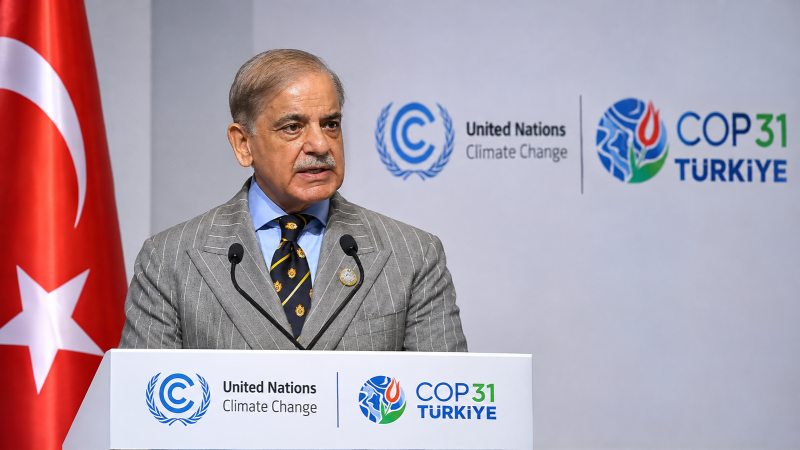
Prime Minister Shehbaz Sharif has called for a fundamental shift in global climate financing, urging wealthy nations and international financial institutions to provide grant-based assistance and substantially increase resilience and funds for climate-vulnerable countries, warning that the existing financial framework risks pushing struggling economies deeper into debt.
Addressing the COP31 climate summit in Antalya, Turkiye, on Thursday, the prime minister argued that countries bearing the greatest consequences of climate change should not be forced to shoulder additional financial burdens to recover from disasters they have contributed least to causing.
“When climate disasters strike, vulnerable countries need timely help and finance that does not deepen their debt,” Shehbaz said, making a case for grant-based financing, including public-private partnerships, alongside a significant increase in resilience and adaptation funding. “National effort cannot replace a fair and just global response,” the prime minister warned, highlighting the widening gap between the climate commitments made by developed countries and the financial assistance reaching vulnerable nations.
His remarks come as developing economies face mounting pressure to address increasingly destructive climate events while navigating fiscal constraints, rising debt obligations and limited access to affordable financing. For Pakistan, the climate financing question carries particular significance following the devastating 2022 floods, which exposed the country's vulnerability to extreme weather and the enormous economic costs of climate-induced disasters.
Shehbaz highlighted Pakistan's efforts to promote clean energy, signalling Islamabad's commitment to transitioning towards a more sustainable energy model. However, his intervention also underscored a persistent contradiction in international climate politics: developing countries are expected to accelerate their green transitions while struggling to secure the financial resources needed to make them possible.
“In 2022, one-third of Pakistan was submerged due to devastating flash floods. 33 million people were affected. Standing crops were washed away, and millions of acres of land were inundated. More than 1,700 people lost their lives, and economic losses exceeded $30 billion. Four years ago, at the United Nations, I warned: What happens in Pakistan will not stay in Pakistan. Mr. President, unfortunately, that warning has become a stark reality.” Prime Minister Muhammad Shehbaz Sharif addressing a high-level session of COP31 in Antalya, Türkiye
— Government of Pakistan (@GovtofPakistan) November 12, 2026
On the sidelines of the summit, the prime minister also held a meeting with Sudan's President of the Transitional Sovereignty Council, General Abdel Fattah al-Burhan. According to a statement issued by the Prime Minister's Office, Shehbaz reaffirmed Pakistan's longstanding relations with Sudan and reiterated Islamabad's support for the country's sovereignty, unity and territorial integrity. He also expressed solidarity with the Sudanese people amid the country's continuing challenges. The meeting highlighted Pakistan's diplomatic engagement with Sudan at a time when the African country continues to grapple with a devastating conflict and a deepening humanitarian crisis.
Prime Minister of Pakistan, Muhammad Shehbaz Sharif, held a meeting with H.E. General Abdel Fattah al-Burhan, President of the Transitional Sovereignty Council of the Republic of Sudan, on the sidelines of the High-Level Segment of the COP31 in Antalya, Türkiye today. During the meeting, the Prime Minister reaffirmed Pakistan's longstanding and brotherly ties with Sudan and reiterated Pakistan's steadfast support for Sudan's sovereignty, unity and territorial integrity. He expressed solidarity with the brotherly people of Sudan amid the prevailing challenges. The two leaders had a productive exchange on ways to further strengthen bilateral relations in diverse areas of mutual interest. They also exchanged views on the challenge posed by climate change, and emphasized the importance of enhanced international cooperation to address its impact, particularly on the developing countries. Both sides also reaffirmed their commitment to maintaining close coordination at multilateral fora. #COP31 #COP31Antalya
— Prime Minister's Office (@PakPMO) November 12, 2026
Further, the prime minister also met the president of Iraq, Nizar Mohammed Saeed Amidi. PM Shehbaz congratulated President Amidi and the people of Iraq on the successful conduct of parliamentary elections and formation of the new government. He reaffirmed Pakistan’s steadfast support for Iraq’s sovereignty, territorial integrity, national unity and stability.
Prime Minister of Pakistan Muhammad Shehbaz Sharif met with H.E. Mr. Nizar Mohammed Saeed Amidi, President of the Republic of Iraq, on sidelines of COP31 today. The Prime Minister congratulated President Amidi and the brotherly people of Iraq on successful conduct of parliamentary elections and formation of the new Government. He reaffirmed Pakistan’s steadfast support for Iraq’s sovereignty, territorial integrity, national unity and stability. The two leaders reaffirmed the longstanding brotherly relations between Pakistan and Iraq, rooted in shared faith, historical bonds and strong people-to-people contacts. Expressing satisfaction over the positive momentum in bilateral relations, they underscored the importance of sustained high-level exchanges and institutional engagement. The Prime Minister also extended an invitation to President Amidi to visit Pakistan at a mutually convenient time. The two sides reviewed the entire spectrum of bilateral cooperation, with particular focus on trade, investment, manpower, reconstruction, agriculture, and defence. The Prime Minister appreciated Iraq’s facilitation for Pakistani Zaireen. The two leaders also exchanged views on regional and international developments and reaffirmed their commitment for close coordination at multilateral fora. #COP31 #COP31Antalya
— Prime Minister's Office (@PakPMO) November 12, 2026
In a separate engagement, Shehbaz met Finnish President Alexander Stubb to review bilateral relations and explore avenues for expanding cooperation in areas of mutual interest. The PMO said the meeting provided an opportunity to strengthen Pakistan-Finland relations, although no specific agreements or new cooperation initiatives were detailed in the statement.
Prime Minister of Pakistan, Muhammad Shehbaz Sharif met President of Finland Alexander Stubb today on the sidelines of the 31st Conference of the Parties (COP31) in Anatalya, Turkiye. The meeting provided an opportunity to review Pakistan–Finland relations and strengthening cooperation in areas of mutual interest. The Prime Minister reaffirmed Pakistan’s desire to translate the longstanding and friendly relations into a forward-looking partnership encompassing trade and investment, education and skills development, technology, climate resilience and people-to-people contacts. The Prime Minister noted the considerable potential to increase bilateral trade and welcomed the presence of Finnish companies including Nokia, Wärtsilä, Metso and Vaisala in Pakistan. He encouraged greater business-to-business engagement, technology transfer and investment in telecommunications, advanced manufacturing, clean technologies and mining. The two leaders exchanged views on climate change, disaster risk reduction and environmental cooperation. The Prime Minister expressed interest in Finnish technical expertise in flood forecasting, water management, climate-resilient agriculture, glacier monitoring and early-warning systems. Underlining the importance of dialogue, mediation and peaceful settlement, the two leaders exchanged views on ongoing diplomatic efforts for peaceful and durable solutions to the conflicts in Ukraine and West Asia. President Stubb appreciated Pakistan’s role in facilitating dialogue and mediation between Iran and the United States. The two leaders reaffirmed the importance of maintaining regular engagement and exploring practical avenues to deepen bilateral cooperation. The Prime Minister reiterated the invitation to President Stubb to undertake an official visit to Pakistan at a mutually convenient time. #COP31 #COP31Antalya
— Prime Minister's Office (@PakPMO) November 12, 2026
The prime minister's engagements at COP31 thus combined climate diplomacy with bilateral outreach, placing Pakistan's demand for climate justice alongside its broader efforts to strengthen international partnerships.