
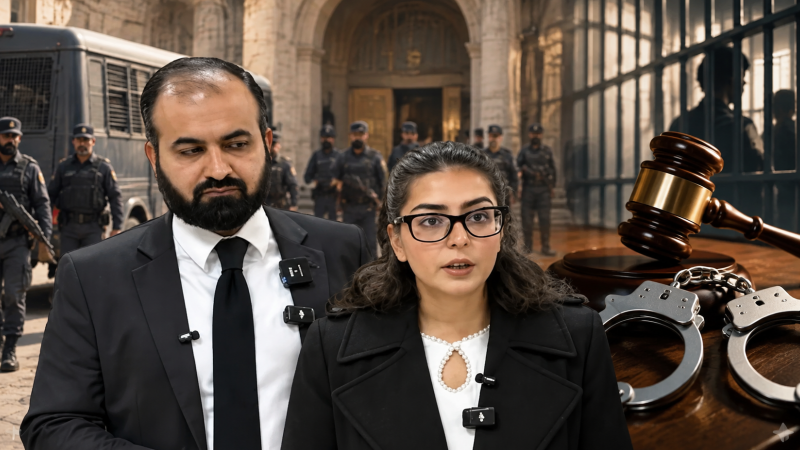
The Islamabad Anti-Terrorism Court (ATC) has sentenced prominent human rights lawyers Imaan Zainab Mazari-Hazir and Hadi Ali Chattha to 10 years in prison each in a case involving the alleged removal of security barriers installed for the movement of an international cricket team in the capital. Special Court-II Judge Tahir Abbas Sipra announced the verdict at Adiala Jail on 29 October 2026. The court also imposed fines under the Anti-Terrorism Act, 1997, and the Pakistan Penal Code (PPC), with the sentences under the relevant provisions to run concurrently.
The case stems from an incident on Faisal Avenue near the Zarai Taraqiati Bank of Pakistan (ZTBL) building on 25 October 2024, when police had installed barriers and positioned a Mazda vehicle to regulate traffic and secure the route of an international cricket team travelling towards Zero Point. The prosecution alleged that the two lawyers interfered with the security arrangements, removed barriers and assaulted police personnel deployed on duty.
According to the prosecution, police officials were performing security duties to facilitate the movement of the visiting team, which had been accorded the status of state guests. The officials were tasked with preventing any potential security threat during the team's movement.
The prosecution maintained that Mazari and Chattha arrived at the site and began arguing with police officers over the barriers. Mazari allegedly identified herself as a lawyer and questioned the officers' authority to block the road, while Chattha allegedly attempted to remove the barriers. When Constable Ibrahim Khan tried to restore them, Chattha allegedly assaulted him by punching and slapping him. The prosecution further alleged that the two threatened police personnel and that the confrontation created fear among those present.
The police subsequently registered a case against the lawyers. During the trial, the prosecution presented nine witnesses, seven of whom appeared before the court. The prosecution also relied on video footage of the incident, which was recovered through a USB device and examined by the Federal Investigation Agency's Cyber Crime Wing. The court considered the footage alongside testimony from police officials and other evidence, finding the prosecution's case established.
The defence rejected the allegations, arguing that the case was politically motivated and that the couple had themselves been subjected to police violence. Mazari maintained that police personnel had assaulted her during the confrontation and that the prosecution's account was inconsistent with the video footage. The defence also argued that the incident concerned a dispute over road access and security arrangements rather than conduct amounting to terrorism.
The lawyers challenged the invocation of terrorism-related provisions, with their counsel referring to Supreme Court judgments concerning the distinction between ordinary criminal offences and terrorism under the Anti-Terrorism Act. They also contested the legality of the proceedings and maintained that their rights to due process and a fair trial had been violated.
Background: A Series of Cases Against the Two Lawyers
The latest conviction comes amid a series of criminal proceedings against Mazari and Chattha, two prominent lawyers known for representing journalists, political activists, human rights defenders and families seeking information about relatives allegedly subjected to enforced disappearances. Their prosecution has attracted criticism from international human rights organisations, which have raised concerns about the treatment of lawyers engaged in human rights work.
On 24 January 2026, an Islamabad sessions court sentenced Mazari and Chattha to 17 years in prison each in a separate case involving their social media posts. The convictions were handed down under provisions of the Prevention of Electronic Crimes Act (PECA), 2016, including those concerning glorification of an offence, cyber terrorism and false or fake information. The court also imposed fines of Rs36 million on each of them.
The prosecution alleged that posts published on X between 2021 and 2025 contained anti-state material, incited ethnic hatred and undermined state institutions. Chattha faced charges relating to sharing and reposting material published by Mazari. The lawyers denied wrongdoing and challenged the proceedings.
Amnesty International and other rights organisations criticised the convictions and raised concerns about alleged procedural irregularities and restrictions on the defendants' ability to defend themselves. In September 2026, the Supreme Court suspended their sentences and ordered their release pending the final decision on their appeals. The reprieve was short-lived: police took the two lawyers into custody again at Adiala Jail on the same day in connection with another case involving allegations of obstructing officials and disrupting proceedings outside the Islamabad High Court.
The security barriers case also proceeded while the lawyers remained in detention. Their counsel challenged the framing of charges and the inclusion of terrorism-related provisions before the Islamabad High Court. The high court heard their challenges but had not resolved the dispute before the ATC delivered its verdict. The defence also sought to defer the announcement, arguing that applications remained pending before the superior courts.
The trial concluded at Adiala Jail in late October, with both lawyers recording their statements under Section 342 of the Code of Criminal Procedure and the prosecution completing its final arguments. The ATC reserved its verdict before announcing the sentences on 29 October.
The latest ruling adds another set of convictions to the legal battles facing the two lawyers. Their earlier PECA sentences had already drawn international scrutiny over freedom of expression, fair-trial safeguards and the potential consequences for human rights advocacy in Pakistan. The new verdict is likely to intensify scrutiny of the use of anti-terrorism legislation in cases involving alleged obstruction of official duties, as well as the legal limits of state security measures and the right to challenge restrictions imposed by authorities.