
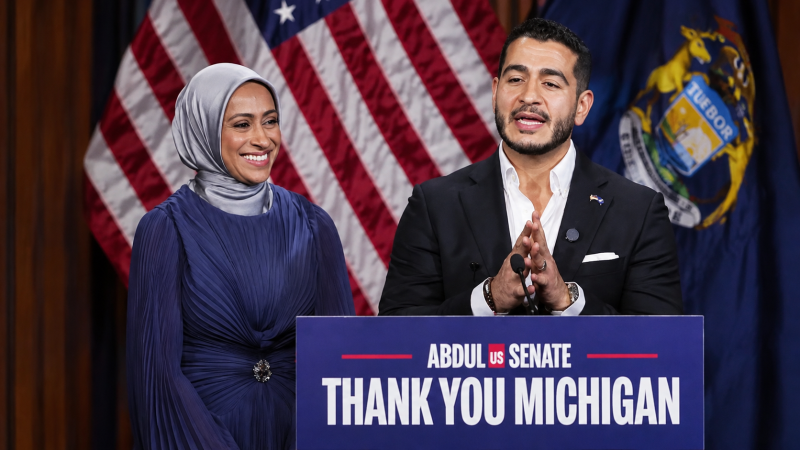
DETROIT: Democratic candidate Abdul El-Sayed has secured a landmark victory in Michigan’s US Senate race, defeating Republican former congressman Mike Rogers in a closely watched contest that exposed the political costs of religious prejudice, identity-based attacks and an increasingly polarised American political landscape.
El-Sayed, who declared victory in the early hours of November 4 at an election-night gathering at The Department at Hudson’s in Detroit, took the stage alongside his wife, Dr Sarah Jukaku, to celebrate a result that will make him the first Muslim American elected to the United States Senate. His victory marks a significant political breakthrough for Muslim Americans and the progressive wing of the Democratic Party.
The 42-year-old former public health official won approximately 53 per cent of the vote against Rogers’ 45 per cent, according to election results reported by US media. The contest was particularly consequential because Michigan’s open Senate seat, vacated by retiring Democratic Senator Gary Peters, had become a major battleground in the struggle for control of the upper chamber.
Beyond its electoral significance, El-Sayed’s victory represents a direct challenge to a campaign increasingly defined by attempts to turn his religious identity and Arab-American background into political liabilities. President Donald Trump and Republican allies repeatedly targeted his Muslim faith, questioned his political loyalties and sought to portray his progressive positions as a national security concern.
El-Sayed's campaign, however, was not built exclusively around resistance to discrimination. He mobilised voters through an ambitious economic and healthcare platform, promising Medicare for All, stronger protections for working families, higher taxes on billionaires and restrictions on corporate influence in politics. His message resonated with younger voters and sections of the electorate frustrated with the influence of wealthy donors and established political interests.
U.S. Senate candidate @AbdulElSayed (D-MI) to opponent Mike Rogers (R-MI): "Enjoy your retirement...you chose hate, and Michigan chose hope. May we never have to see the likes of you in this state again." https://t.co/YY9PjsgAzx
— CSPAN (@cspan) November 4, 2026
The campaign also drew national attention over El-Sayed’s criticism of US military support for Israel and his condemnation of Israeli actions in Gaza. His position attracted criticism from pro-Israel groups and sections of the electorate, while supporters viewed it as a challenge to Washington's longstanding foreign-policy consensus.
In his victory speech, El-Sayed invoked the Arabic expressions inshallah and alhamdulillah, transforming language that had previously been weaponised against him into an expression of political confidence and celebration. His message carried significance beyond Michigan, particularly for communities whose religious identities have increasingly become targets in American electoral politics.
For now, Michigan has delivered a powerful electoral rebuke to identity-based campaigning. El-Sayed's victory demonstrates that attempts to turn religion and ethnicity into political disqualifications can fail when voters prioritise economic concerns, democratic representation and political accountability.