
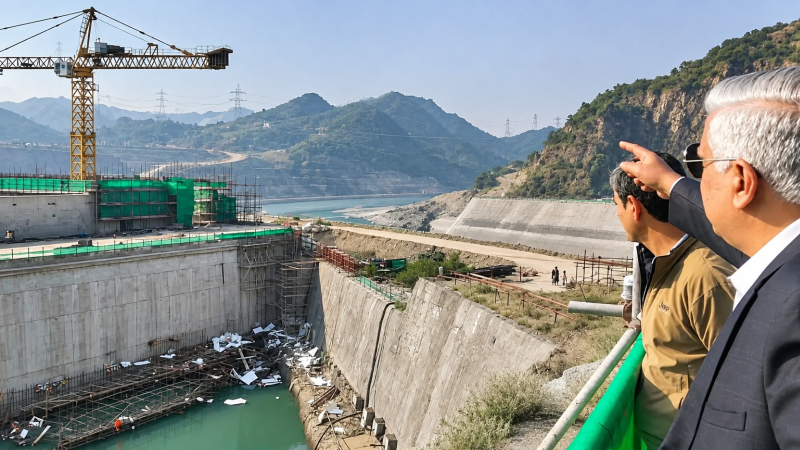
SWABI: A rock mass collapse at the construction site of the Tarbela Dam Fifth Extension Hydropower Project (T-5) has triggered debate, raising serious concerns over construction safety, potential damage to critical structures and the mounting financial burden of prolonged delays.
The incident occurred on Monday when a section of rock collapsed at the project site, allowing a surge of water to enter nearby working areas, according to the Water and Power Development Authority (Wapda). The sudden influx of water disrupted construction activities and prompted authorities to assess the condition of the tunnel, powerhouse and other structures within the affected area.
Deputy Commissioner Haripur Waseem Ahmed said an assessment was under way to determine whether the incident had caused damage to the tunnel, powerhouse or other infrastructure. Meanwhile, Swabi Deputy Commissioner Nasarullah Khan said additional water had been released from Tarbela Dam owing to what he described as "unavoidable" reasons. The release was expected to increase the flow and water level of the Indus River, adding another dimension to the situation surrounding the construction site.
During excavation of the 2nd Bench Connecting Tunnel at Tarbela 5th Extension, weak rock collapsed causing Intake Pit water to enter the tunnel. All workers are safe. No damage to main tunnel, powerhouse, tailrace or switchyard. Reports of tunnel collapse are incorrect. https://t.co/XuPKYH0eRG
— WAPDA (@wapda_pr) November 9, 2026
The latest incident comes as the already troubled project faces substantial delays and a dramatic escalation in its estimated cost. Its completion has been pushed back by at least two years, while the projected expenditure has surged from Rs82 billion to Rs317 billion, representing an increase of more than 285 per cent.
The cost escalation raises questions about project management, financial oversight and the institutional capacity to deliver major infrastructure schemes within their original timelines and budgets. While the precise causes of the latest collapse remain under investigation, the incident adds to the challenges facing a project whose financial and operational difficulties have already placed considerable pressure on public resources.
In a statement issued on Tuesday, Wapda said its chairman, retired Lieutenant General Muhammad Saeed, visited the construction site on Tuesday following the incident to review the situation and assess the response. During his visits, the chairman inspected the intake structure, tunnel, powerhouse and other critical components of the project. Consultants, contractors and Wapda's project management team briefed him on the prevailing situation and the measures taken in response to the collapse.
However, the immediate response and assurances of preventive action leave several critical questions unanswered, particularly regarding the extent of structural damage, accountability for the incident and the possibility of further delays. Wapda has yet to establish publicly whether the collapse was linked to geological instability, construction-related factors or other operational circumstances.
For a hydropower project already burdened by a more than threefold increase in its original estimated cost, another disruption could deepen concerns over its financial viability and delivery timeline. The incident underscores the need for a transparent technical investigation, independent assessment of the affected structures and clear disclosure of the measures being taken to protect workers, infrastructure and public investment. With billions of rupees already committed, the central challenge for Wapda is no longer simply managing another construction setback but demonstrating that the project can be completed safely, efficiently and without further escalation in public expenditure.