
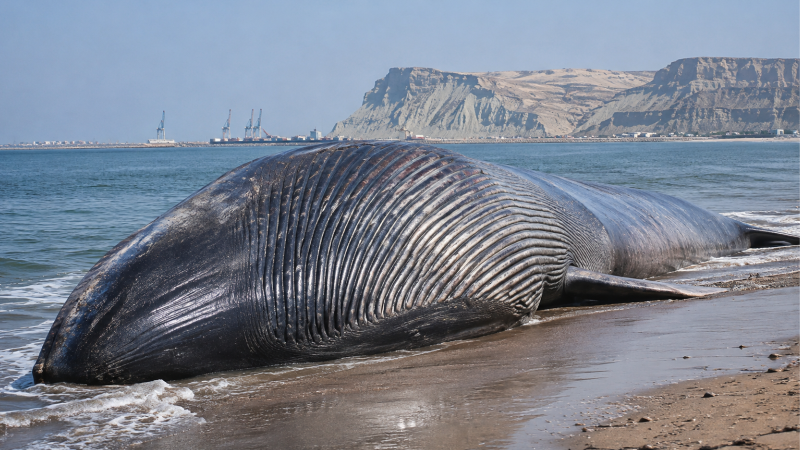
A 30-foot blue whale, one of the ocean’s most extraordinary and endangered inhabitants, has been found dead near Gwadar East Bay, exposing once again the vulnerability of Pakistan’s marine ecosystem and raising serious questions about the country’s commitment to protecting its coastal biodiversity.
According to WWF-Pakistan Technical Adviser M Moazzam Khan, the death of a large whale represents a worrying development for marine biodiversity. Preliminary assessments suggest that the animal may have entered shallow waters, where its ability to navigate could have been compromised, eventually causing it to lose its way and drift towards the coastline.
However, the actual cause of death remains unknown. WWF-Pakistan has initiated further investigations to establish the circumstances surrounding the incident. Until scientific assessments are completed, attributing the whale’s death to a particular cause would be premature.
Nevertheless, the incident raises uncomfortable questions about the protection of marine habitats along Pakistan’s coastline. Gwadar, increasingly promoted as a strategic economic and maritime hub under ambitious development plans, is also part of a fragile ecological landscape whose protection cannot remain secondary to infrastructure expansion and commercial interests.
The contradiction between economic ambitions and environmental preparedness deserves greater scrutiny. While policymakers frequently highlight Gwadar’s strategic importance, the protection of its marine environment requires equally serious investment in scientific research, wildlife monitoring, pollution control and institutional capacity.
Large marine mammals are particularly vulnerable to environmental disturbances, including underwater noise, vessel collisions, fishing-related entanglement and changes in their natural habitats. Although none of these factors has been established as responsible for this particular death, they underline the range of threats that require systematic investigation and preventive action.
The discovery of the dead whale should therefore prompt authorities to strengthen coordination between environmental agencies, marine scientists, coastal communities and conservation organisations. Independent investigations, regular monitoring of marine species and stronger protection of critical habitats are essential to prevent further ecological losses.
The whale's death is a sobering reminder that economic development cannot be considered sustainable if the ecosystems supporting coastal life are left unprotected. Gwadar's future should not be measured exclusively through ports, infrastructure and investment figures, but also through the health of its waters and the survival of its marine wildlife.
For a country increasingly looking towards the sea for economic opportunity, allowing marine biodiversity to become an afterthought would be a costly failure of environmental governance.