
WEBDESK - NAYADAUR
Pakistan’s military has rejected Indian claims that a former Pakistan Army soldier was killed during a counterterrorism operation in Indian-administered Kashmir, presenting the retired serviceman before journalists and saying he was alive.
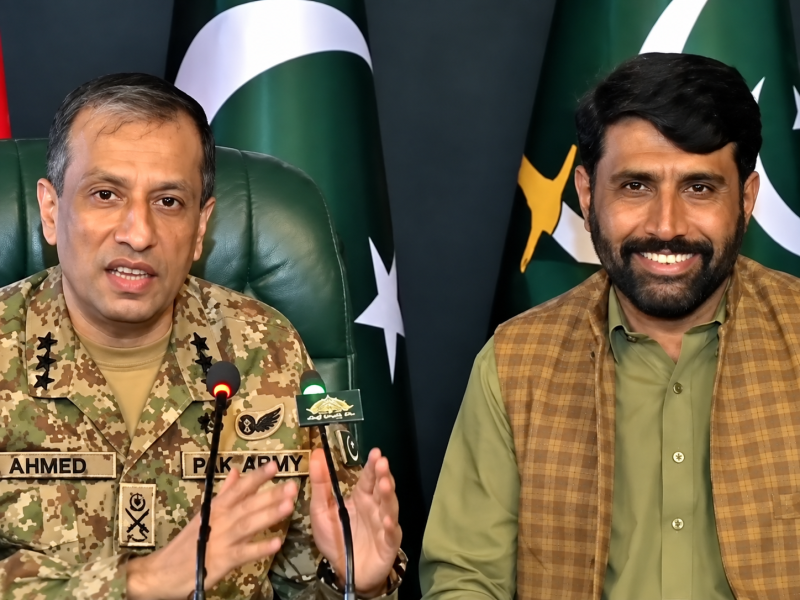
Director General Inter-Services Public Relations (ISPR) Lt Gen Ahmed Sharif Chaudhry said on Thursday that Muhammad Asif, a retired Havaldar who served with the Pakistan Army’s Special Services Group (SSG), had been wrongly identified in Indian reports as Lashkar-e-Taiba (LeT) militant Mohammad Asif alias Hashim Moosa.
India’s military and government institutions had reported that a militant identified as Hashim Moosa or Mohammad Asif was killed during an operation in the Yousmarg area of Budgam district on Sept. 29-30. Indian reports described him as a Pakistan-based LeT commander linked to the April 2025 Pahalgam attack.
Indian authorities said the operation was conducted jointly by the Indian Army, Jammu and Kashmir Police and the Central Reserve Police Force after intelligence inputs indicated the presence of militants in the Korag-Yousmarg area. The Indian Army subsequently said a militant’s body and weapons were recovered during a search operation.
However, Gen Chaudhry said the person identified by Indian media as the former Pakistani soldier was actually alive and living in Pakistan.
During the press conference, Muhammad Asif appeared alongside the ISPR chief and said he had learned about reports of his alleged death through calls and social media.
“I was sitting at home when I heard these false reports,” Asif said, according to Pakistan’s military account. He said he had joined the Pakistan Army in 2000, entered the SSG in 2005 and retired in 2023. Pakistan’s state broadcaster also reported that he has been living in Attock since his retirement.
The Pakistani military said Indian reports had included detailed personal information about the alleged militant, including a photograph, military service number, date of birth and claims about his service with the SSG.
Indian media had reported that Mohammad Asif, also known as Hashim Moosa or Moosa Fauji, had served as a Pakistan Army Havaldar before becoming associated with LeT. Indian outlets have separately reported that the militant was wanted in connection with several attacks in Jammu and Kashmir, including the Pahalgam attack.
The central dispute therefore concerns whether the man killed in the Indian operation was the same individual as the retired Pakistani soldier presented by ISPR.
The Indian government and military have not, in the sources reviewed, publicly acknowledged Pakistan’s presentation of Asif as evidence that their identification was incorrect. Pakistan, meanwhile, has described the episode as a “false flag” operation and accused India of attempting to associate Pakistan with militancy in Kashmir. The Associated Press reported that Gen Chaudhry did not provide independent evidence for his broader allegation that the incident was staged.
The controversy comes amid already heightened tensions between India and Pakistan over Kashmir and allegations of cross-border militancy.
During the briefing, Gen Chaudhry also warned that any further escalation could trigger a severe Pakistani response. He said Pakistan’s armed forces remained prepared to respond to threats to the country’s security and territorial sovereignty.
The incident has now produced two sharply different narratives: Indian authorities say a LeT militant known as Hashim Moosa was killed in a security operation, while Pakistan says the Pakistani former soldier identified with that name is alive and that his identity was wrongly used.
Further independent verification of the identity of the person killed in Kashmir would be required to resolve the competing claims.