
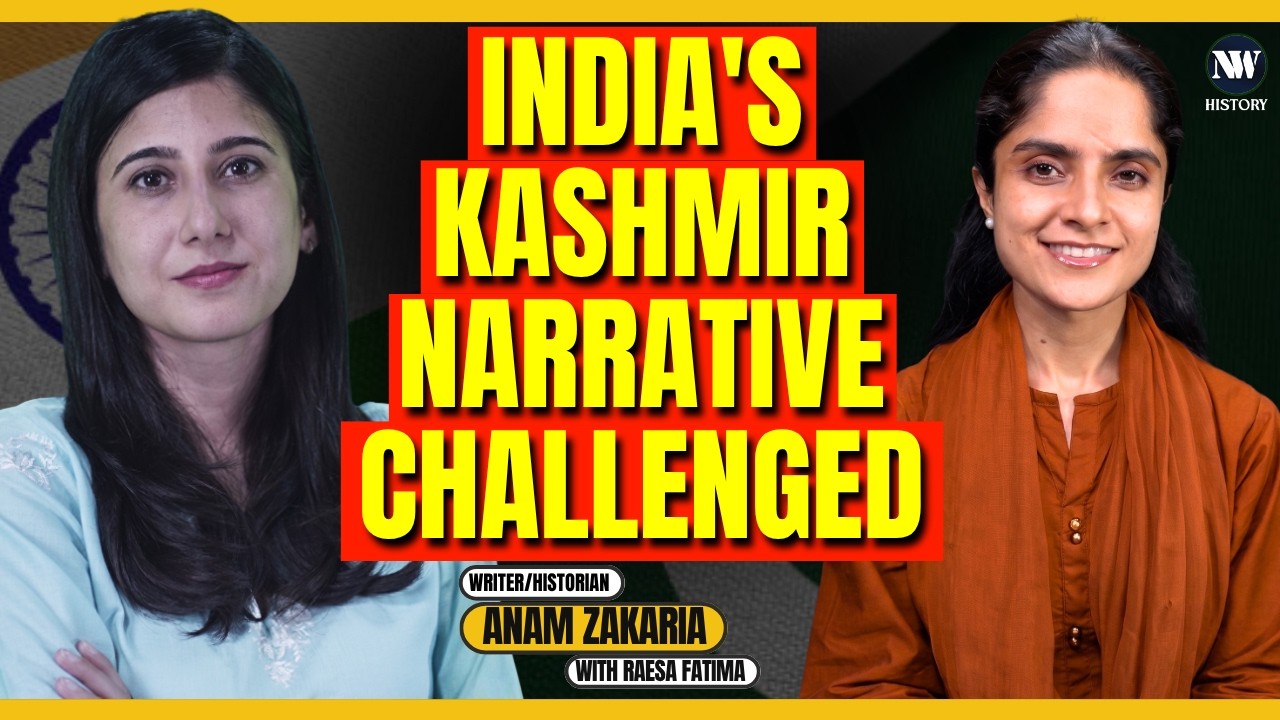
For decades, the Kashmir conflict has largely been narrated through the competing political and strategic claims of India and Pakistan. But beneath those state narratives are the experiences of the people who have lived through conflict, militarisation, political restrictions and repeated upheaval. In a conversation with New Wave History, award-winning Pakistani writer and oral historian Anam Zakaria argues that understanding Kashmir requires moving beyond these official frameworks and listening more closely to Kashmiri voices.
Drawing on her work with oral histories, Zakaria cautions against reducing the conflict to a simple comparison between the two states. She acknowledges serious human-rights concerns in Indian-administered Kashmir while also arguing that Pakistan’s policies in Azad Jammu and Kashmir and Gilgit-Baltistan have their own structural and constitutional consequences. According to her, framing the conflict as a competition over which state bears greater responsibility can ultimately push Kashmiris out of the conversation.
The conversation also examines the consequences of India’s 2019 decision to revoke Jammu and Kashmir’s special constitutional status and reorganise the former state. Zakaria argues that the move deepened political alienation among Kashmiris and says that policies presented in the language of development and progress must also be examined through their effects on political autonomy, dissent and everyday life. She draws on conversations with Kashmiris and her broader research into how official narratives can obscure individual experiences.
On Pakistan’s side, Zakaria questions the assumption that the Pakistani state can speak on behalf of all Kashmiris. She points to constitutional and legal restrictions in Pakistani-administered Kashmir, including requirements concerning allegiance to Pakistan for those seeking elected office, and discusses their implications for political expression and movements advocating alternatives to both Indian and Pakistani control.
For Zakaria, Kashmir is therefore not only a territorial dispute. It is also a contest over narratives, political agency, geography, water and strategic interests. She argues that the competing national stories of India and Pakistan can leave little room for Kashmiris themselves to articulate their political aspirations.
The discussion ultimately returns to the possibility of a political solution. Zakaria argues that such a solution requires sustained political engagement rather than simply dismissing movements or applying labels. She also reflects on the power of terms such as “terrorism”, arguing that once a conflict is reduced to a label, the political questions surrounding it can disappear from public discussion.
The conversation presents Kashmir through a different lens: not simply as a dispute between two states, but as a history in which the voices, memories and political aspirations of Kashmiris remain central to understanding the conflict.