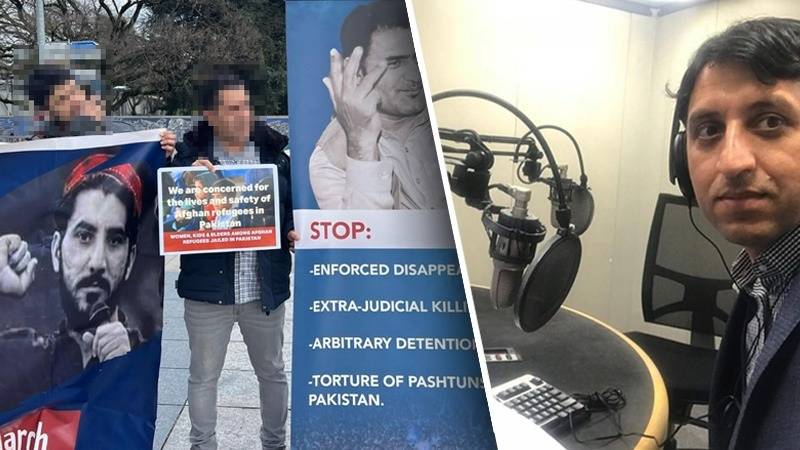
Dutch police have registered a police case involving Zafar Khan, a Pashtun journalist based in the Netherlands, following alleged threats and intimidation linked to individuals associated with the Pashtun Tahafuz Movement (PTM) Europe, according to official police records, the documentary evidence of which is available with Naya Daur Media.
The case was registered on 8 September 2025 and relates to incidents that began after a Facebook interaction on 20 August 2025, when Khan publicly criticized the Taliban.
According to the police case file, the matter began when Khan commented on a Facebook post by Abdullah Ehsan, identified in the record as being associated with Pashtun Tahafuz Movement Europe. The post showed Ehsan holding the flag of Afghanistan’s former government. Khan praised the display of the former flag and expressed opposition to the Taliban.
BREAKING
— Naimat Khan (@NKMalazai) December 29, 2025
Dutch authorities have recorded a complaint concerning Zafar Khan, a Netherlands-based Pashtun journalist, after he reported alleged threats and intimidation connected to individuals linked with PTM Europe, official police documents show. pic.twitter.com/0t9VT4O3b1
Following the comment, Khan said he was publicly accused of having links with Pakistan’s intelligence agencies, an allegation he told police carries serious consequences within the Pashtun community, including social exclusion and reputational harm.
The police file states that Khan later received hostile responses, including a message attributed to Malik Bazai, identified as PTM’s chief for Europe, stating: “A crooked mouth is straightened with a fist.”
According to the case record, the escalation continued through voice messages. In one voice note, Bazai allegedly told Khan:
“Whenever I find you, I will do what a true Afghan does to others,” a statement Khan interpreted as a direct threat.
In a subsequent voice message, Bazai allegedly used abusive language and demanded Khan’s contact details, saying:
“What kind of [expletive] have you started? Send me your WhatsApp number.”
The police case further notes that Bazai later contacted Khan directly, leading to a phone conversation lasting approximately 31 minutes. During the call, Bazai allegedly discussed PTM Europe’s political stance and referenced another Pashtun activist in France, implying that silence resulted from fear of violence in Europe.
Khan told police that Bazai later made a statement swearing “on the death of his mother” that similar harm could be inflicted on him—an oath Khan described as culturally significant and intended to underscore the seriousness of the threat.
As a result of the alleged threats, Khan stated that he no longer feels safe attending professional or community gatherings and fears for his personal safety. He requested protection of his personal details and police intervention.
Dutch police confirmed that the matter has been registered as a police case involving alleged threats. The case remains under review.
At the time of publication, Pashtun Tahafuz Movement Europe and the individuals named in the case had not publicly responded to the allegations. However, the complainant said that police will further investigate the matter and the case has been taken seriously.
The case has emerged at a time when Pakistani Pashtun journalists, analysts, and academics are increasingly raising concerns that PTM has become hostage to diaspora influence, distancing itself from political and social realities on the ground.
Rafiullah Kakar, an expert in the political economy of development and conflict, who has a deep understanding of Pashtun nationalist movements, said in a recent podcast that:
“PTM has always kept its demands within the Constitution of Pakistan. However, PTM committed serious blunders. Earlier, Pashtun youth from every social class could be seen at the forefront. Today, apart from Manzoor himself, there is no one left on his right or left—only his personal cult remains.”
He also stated that PTM became divided over leadership and internal positions. According to him, the movement began to give importance far beyond the actual weight of certain individuals—particularly those sitting abroad. These include Afghans and old-school Pashtun revolutionaries originally from this land (Pakistan). Sitting safely abroad, they act as ‘armchair revolutionaries,’ living secure lives and running their businesses while imposing radical agendas on PTM that are completely disconnected from ground realities.
He added that Manzoor’s personal rule enabled this situation, as he gave space to these external actors. Meanwhile, local leadership that raised questions and on-ground workers were sidelined.
In another podcast hosted by Peshawar University faculty members Dr. Faizullah Jan and Dr. Syed Irfan Ashraf, the discussion focused on the perceived failure of the Pashtun Tahafuz Movement (PTM). Dr. Faizullah Jan maintained that the public initially viewed PTM as a revival of Bacha Khan’s movement. Many Pashtuns who had previously been apolitical, particularly educated youth, became politically active through PTM. However, he argued that those who were mobilized later disappeared from the political scene, and the movement eventually fractured. Mohsin Dawar parted ways with PTM and formed the National Democratic Movement (NDM), which Dr. Jan described as more of a think tank than a conventional political party.
Dr. Syed Irfan Ashraf stated that once the movement gained strength and expanded, there was a clear need to broaden and formalize its organizational structure. Such expansion required resources and sustained effort. Over time, PTM’s organizational processes became disputed, leading to prominent figures such as Afrasiab Khattak and Mohsin Dawar distancing themselves. Female activists also took different paths, despite PTM and women activists sharing overlapping but distinct concerns.
Dr. Ashraf noted that PTM gradually became dependent on diaspora funding. He clarified that this reliance was not a fault of either PTM or the diaspora. Many Pashtuns living in Europe and the Gulf countries were genuinely committed to supporting their people and highlighting their suffering. According to him, numerous well-off individuals collected donations and invested time and effort to support PTM’s struggle and meet its financial challenges so activists on the ground could continue their work.
However, over time, Dr. Ashraf observed that the movement’s narrative was hijacked from afar. He felt that PTM’s leadership created a vacuum, which allowed this shift to occur.
Dr. Jan argued that both PTI and PTM faced difficulties due to the role played by their respective diaspora communities. He cited the example of former KP Chief Minister Ali Amin Gandapur, claiming his removal was influenced by individuals based in Europe and the United States. Similarly, Sohail Afridi’s nomination was officially attributed to party decisions but was, in Dr. Jan’s view, driven by diaspora influence.
According to Dr. Jan, the diaspora possesses financial resources and enjoys political freedom. Due to their wealth, they have access to power corridors abroad, enabling them to lobby and pass resolutions through local politicians. This strengthened their influence within parties in Pakistan, allowing them to exercise remote control. Meanwhile, the consequences, violence and repression, were borne by workers on the ground.
Dr. Ashraf disagreed, stating that PTI and PTM were fundamentally different, particularly because PTM’s grassroots workers largely came from marginalized backgrounds.
In response, Dr. Jan argued that the Pashtun diaspora played a similar role in PTM. While they earned money through hard work and enjoyed freedom abroad, their financial strength eventually gave them disproportionate control. According to him, once they gained influence, they exaggerated Manzoor Pashteen’s statements and pushed slogans to extremes, such as “Pakistan Murdabad.” He added that the term “Punjabi” was turned into an insult. As a result, local PTM leadership distanced itself, and Manzoor Pashteen became, in effect, hostage to diaspora actors, particularly those promoting Afghanistan’s narrative through their personal platforms.
Dr. Ashraf responded that while the diaspora may have acted in good faith, they ignored Pakistan’s social reality—that Punjabis, Sindhis, Baloch, and Pashtuns live together in a federal system. Awareness of this reality, he argued, was essential for meaningful political contribution and organizational growth. He also emphasized that PTM’s diaspora support could not be equated with PTI’s in financial terms. While PTI’s diaspora could contribute billions, PTM’s supporters mainly offered moral and limited financial support.
Dr. Jan concluded by stating that PTM initially politicized people through humanistic ideals, but quickly devolved into chauvinism. Chauvinistic slogans, including derogatory language against Punjabis, replaced inclusive politics, going beyond even racism.
He emphasized that there is no inherent conflict between Pashtuns and Punjabis; they are allies who live together. He cited the example of Manzoor Pashteen being warmly welcomed in Lahore, where a public gathering was held in his support.