
WEBDESK - NAYADAUR
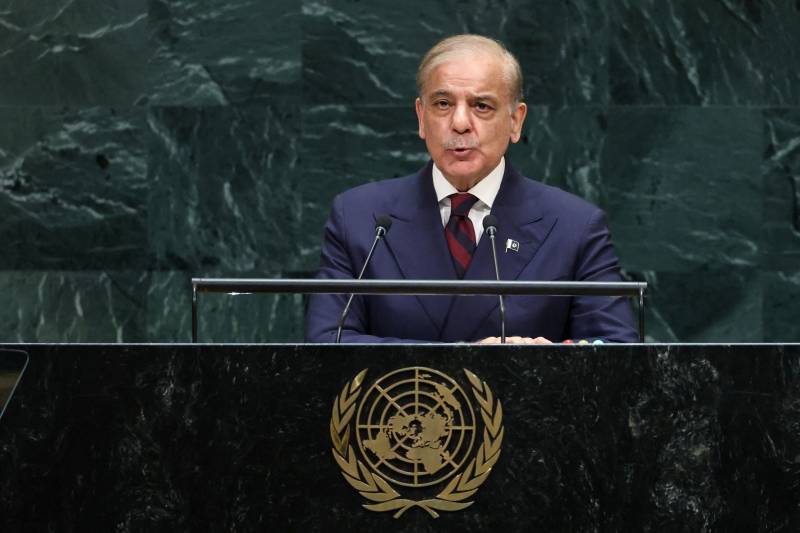
Pakistan Prime Minister Shehbaz Sharif told the United Nations General Assembly on Friday that any attack on Makkah or Madinah would cross a “red line,” as Saudi Arabia faces heightened security threats from Houthi attacks.
Speaking during the UN General Assembly in New York, Sharif said any threat to the safety and sanctity of the Haramain Sharifain — the two holiest mosques in Islam — was unacceptable.
“No Muslim can even dare to think of committing such a heinous crime,” Sharif said, emphasizing the religious significance of Makkah and Madinah.
His remarks came after Saudi air defenses intercepted and destroyed a Houthi drone south of Makkah last week before it entered prohibited airspace over the holy city. Saudi authorities described the security of Makkah, its visitors and pilgrims as a red line. The Houthis denied targeting the holy city and called Saudi claims an “outright lie.”
The episode has added to concerns over the widening security situation in the region, with Houthi attacks against Saudi Arabia intensifying amid a broader escalation involving Iran-aligned armed groups.
Pakistan, Saudi Arabia and Türkiye strengthen defense coordination
Sharif’s comments also came as Pakistan, Saudi Arabia and Türkiye moved to deepen their military coordination under a recently signed defense agreement.
The three countries agreed to arrange an urgent meeting of their military chiefs to discuss ways to support Saudi Arabia under the Makkah Defence Agreement. The agreement stipulates that an attack against one signatory constitutes an attack against all three members.
The military chiefs subsequently met in Riyadh, where they reviewed threats facing Saudi Arabia and discussed greater intelligence sharing, military coordination and capability integration.
The agreement was signed by Pakistan, Saudi Arabia and Türkiye in August as the three countries sought to strengthen their defense cooperation. Türkiye has separately expressed readiness to assist Saudi Arabia with military requirements under the pact, while Pakistan has reiterated its commitment to the Kingdom's defense.
Rising pressure on Saudi Arabia
The developments come as Saudi Arabia confronts repeated missile and drone attacks linked to the conflict in Yemen. Saudi-led forces have intercepted multiple Houthi projectiles in recent days, including attacks targeting Saudi cities and infrastructure.
Saudi Arabia has sought greater support from its international partners as the attacks intensify. During meetings on the sidelines of the UN General Assembly, Saudi Foreign Minister Prince Faisal bin Farhan, Pakistan’s Deputy Prime Minister and Foreign Minister Ishaq Dar and Türkiye’s Foreign Minister Hakan Fidan discussed the security situation and reaffirmed Riyadh’s right to defend itself under international law.
Sharif’s UN remarks therefore came at a significant moment for Pakistan’s relationship with Saudi Arabia and for the emerging trilateral defense framework.
The immediate focus remains the protection of Saudi territory and critical infrastructure, while the newly established defense partnership faces its first major test amid continuing regional instability.