
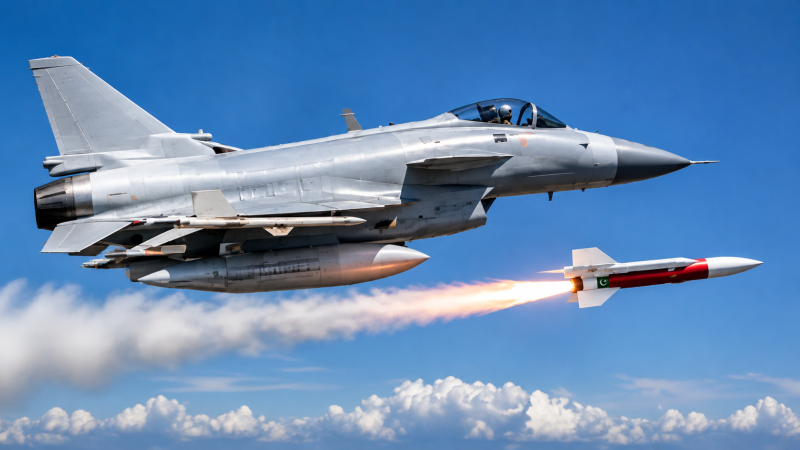
Pakistan has successfully conducted the flight test of its first indigenously developed Fa’az air-to-air missile, marking a significant development in the country’s efforts to strengthen domestic defence production and reduce dependence on foreign military suppliers. However, while the military has presented the test as evidence of technological advancement and growing self-reliance, critical questions remain over the missile’s operational capabilities, production readiness and the broader economic implications of Pakistan’s expanding defence ambitions.
According to the Inter-Services Public Relations (ISPR), the missile is equipped with an advanced terminal guidance system capable of engaging aerial targets at longer ranges. The military’s media wing described the successful flight test, as another milestone in the advancement of Pakistan’s aerospace and defence capabilities.
The launch was witnessed by senior military officers, scientists and engineers involved in the development of the weapon system. President Asif Ali Zardari, Prime Minister Shehbaz Sharif, Chief of Defence Forces and Chief of Army Staff Field Marshal Asim Munir, and the services chiefs subsequently congratulated the scientists and engineers. Developed through Pakistan’s domestic defence research infrastructure under the National Engineering and Scientific Commission (NESCOM), the Fa’az programme reflects an effort to strengthen the country’s capacity to design and produce sophisticated airborne weapons. Global Industrial and Defence Solutions (GIDS), the state-owned defence marketing organisation, is associated with the promotion and marketing of Pakistan’s indigenous defence products.
PAKISTAN SUCCESSFULLY CONDUCTS FLIGHT TEST OF FIRST INDIGENOUSLY DEVELOPED FA’AZ AIR- TO-AIR MISSILE Pakistan has conducted successful flight test of first indigenously developed Fa’az air- to-air missile, marking another significant milestone in the advancement of national aerospace and defense capabilities. Equipped with state of the art terminal guidance system, it can engage enemy aerial targets at longer ranges. Fa’az will significantly enhance operational flexibility of Pakistan Air Force, further strengthening the country’s overall defense posture. The successful flight test underscores the technical maturity, innovation and self reliance achieved by Pakistan’s defense industry. The launch was witnessed by senior officers of the Pakistan Armed Forces, along with distinguished scientists and engineers who played a pivotal role in the development of this advanced weapon system. The President, Prime Minister of Pakistan, COAS & CDF and Services Chiefs have congratulated the scientists and engineers on this remarkable achievement.
— DGPR (AIR FORCE) (@DGPR_PAF) November 3, 2026
The missile’s development is particularly significant given the Pakistan Air Force’s continued reliance on imported air-to-air weapons, including American AIM-120 AMRAAM and Chinese PL-series missiles. An operationally successful indigenous alternative could provide greater flexibility in maintaining fighter aircraft, managing supply-chain vulnerabilities and reducing exposure to geopolitical restrictions on military procurement.
However, the announcement has offered limited technical information. The ISPR has not disclosed the missile’s confirmed engagement range, speed, seeker configuration, production timeline or expected induction into operational service. The distinction between successfully testing a prototype and deploying a reliable operational weapon is particularly important. A flight test demonstrates progress, but it does not independently establish performance under complex combat conditions, production scalability or long-term reliability.
The development also comes against the backdrop of heightened regional military competition, particularly following the May 2025 confrontation between Pakistan and India, which brought air power, beyond-visual-range missile capabilities and military preparedness into sharper focus. Both countries continue to modernise their aerial combat capabilities, making indigenous weapons development an increasingly important component of their defence strategies.
Nevertheless, Pakistan’s pursuit of military self-reliance must extend beyond ceremonial announcements and successful test footage. It requires sustained investment in research, engineering, industrial capacity, skilled human resources and transparent assessments of procurement costs and operational requirements.