
WEBDESK - NAYADAUR
U.S. President Donald Trump is set to conclude his summit with Chinese President Xi Jinping on Friday with a visit to the U.S. National Archives, where the two leaders are expected to highlight the history and long-term relationship between their countries.
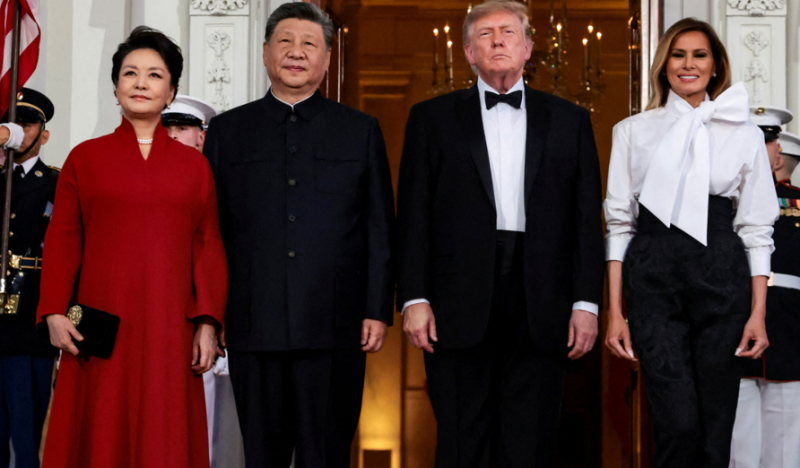
The visit follows a high-profile state summit at the White House that emphasized diplomatic symbolism but produced few major breakthroughs between the world’s two largest economies.
Trump has pointed to progress under a bilateral trade framework, including what he described as greater market access for U.S. farmers and ranchers. The two leaders also identified artificial intelligence as an area where Washington and Beijing could cooperate.
During remarks welcoming Xi, Trump said the leaders would view major American historical documents at the National Archives, including the Declaration of Independence, the U.S. Constitution and the Bill of Rights.
He also highlighted historical and cultural links between the United States and China, saying the two countries had long engaged in trade, learning and cultural exchanges.
China has not publicly commented on the National Archives visit. Analysts, however, say Xi could have an interest in historical records connected to the United States’ decision in 1979 to recognize the People’s Republic of China instead of Taiwan.
Taiwan remains central to talks
Taiwan remains one of the most sensitive issues in U.S.-China relations. Beijing claims Taiwan as part of China and has repeatedly pressed Washington to publicly oppose Taiwanese independence rather than using its longstanding formulation that the United States does not support independence.
China is also seeking an end to U.S. arms sales to Taiwan.
During Thursday’s summit, Xi urged Washington to handle the Taiwan issue with what he called prudence. Chinese state media reported that Xi also called on the United States to maintain what Beijing considers the correct position of opposing Taiwan independence.
The United States does not have formal diplomatic relations with Taiwan but remains its most important international partner. U.S. law requires Washington to provide Taiwan with the means to maintain its self-defense capabilities.
Trump’s comments after Xi’s visit will therefore be closely watched by U.S. allies across Asia, particularly for any indication of changes in Washington’s approach to Taiwan.
Trump previously described a potential second package of arms sales to Taiwan as a negotiating tool after his earlier summit with Xi. His administration had also approved a major arms package for Taiwan.
Analysts have said Beijing could interpret Washington’s restraint on additional arms sales as a longer-term shift rather than a temporary pause.
The summit has also drawn criticism from U.S. Senate Democrats, who said Trump had not secured significant concessions from Beijing on trade, security, artificial intelligence or human rights.
They also criticized the administration for not publicly addressing China’s military pressure on Taiwan and called for previously approved military assistance and arms sales to be delivered.
Trump and Xi’s National Archives visit is expected to provide a symbolic close to a summit in which both sides emphasized stability while leaving several of their most difficult disagreements unresolved.