
WEBDESK - NAYADAUR
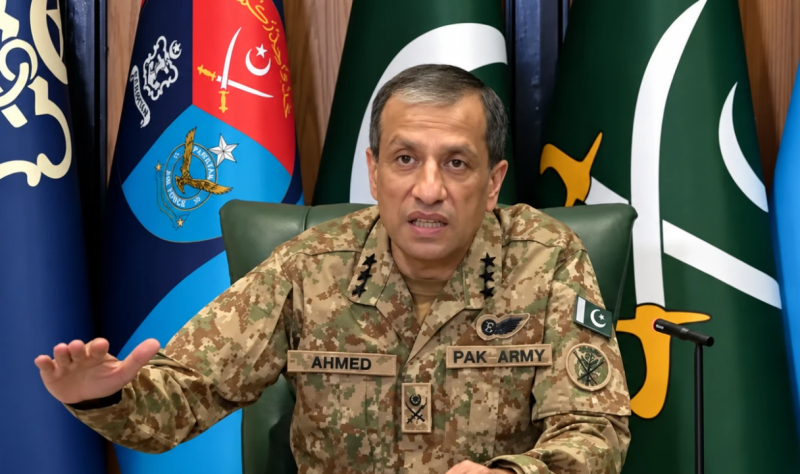
Pakistan’s military has reaffirmed an unconditional commitment to Saudi Arabia’s security, with Director General Inter-Services Public Relations Lt. Gen. Ahmed Sharif Chaudhry saying Islamabad is prepared to go “to any extent” to defend the Kingdom.
In an exclusive interview with Arab News, Chaudhry said Pakistan stood with Saudi Arabia both diplomatically and physically and stressed that there should be no doubt about Islamabad’s commitment to protecting the Kingdom and Islam’s two holiest sites, Makkah and Madinah.
“Our commitment to Saudi security is unconditional,” Chaudhry said, describing the relationship between Pakistan and Saudi Arabia as based on deep historical ties between their peoples, political leaderships and militaries.
He said Pakistan would continue to defend Saudi Arabia against aggression and would respond to what the Saudi leadership and people require within the framework of the two countries’ defense commitments.
The remarks come as Saudi Arabia faces an escalation in missile and drone attacks attributed to Yemen’s Iran-aligned Houthi movement.
Houthi attacks raise pressure on Riyadh
Saudi authorities have reported repeated interceptions of drones and missiles during the latest escalation. On Tuesday, Saudi Arabia said it had intercepted a Houthi drone south of Makkah before it entered the city’s restricted airspace, describing the security of the holy city as a red line. The Houthis denied targeting Makkah.
A separate incident in Taif reportedly resulted in one death after debris from an intercepted drone fell in the western Saudi city, while Saudi officials have reported more than 80 people wounded in recent attacks.
The attacks have also raised concerns over Saudi energy infrastructure. Saudi Arabia’s East-West oil pipeline has been hit by attacks, heightening fears of disruptions to global energy supplies.
The Associated Press reported that Riyadh has approached several countries, including Pakistan, Britain, France and Egypt, for assistance as its stocks of missile-defense interceptors come under pressure. No new military deployment by Pakistan was publicly confirmed in response to those reports.
Chaudhry did not specify whether Saudi Arabia had formally requested additional Pakistani troops, fighter aircraft or air-defense systems, nor did he provide details of any possible Pakistani operational response.
What does the Makkah defense agreement mean?
The statement comes weeks after Pakistan, Saudi Arabia and Türkiye signed the Makkah Joint Defense Agreement on Aug. 7.
Pakistan has described the agreement as defensive and designed to strengthen collective security and deterrence. The pact provides that an armed attack against one of the participating countries is to be regarded as an attack against all three.
However, the full operational provisions of the agreement have not been publicly disclosed. Pakistan’s Foreign Office has said decisions concerning the timing, location, nature and scale of any use of force remain operational matters.
Pakistan already has a military presence in Saudi Arabia. According to reporting cited by Arab News and other outlets, Islamabad deployed personnel and military equipment to the Kingdom earlier this year, including JF-17 fighter jets, drones and an HQ-9 air-defense system.
Chaudhry did not say whether that deployment would be expanded in response to the latest attacks.
Pakistan balances security commitment with diplomacy
While delivering a strong security message to Riyadh, Islamabad is simultaneously pursuing diplomatic efforts to prevent the wider Middle East conflict from expanding.
Field Marshal Asim Munir, Pakistan’s army chief and chief of defense forces, spoke by telephone with Iranian Foreign Minister Abbas Araghchi on Wednesday. Pakistani officials said Munir urged Iran to use its influence with the Houthis to halt attacks on Saudi energy and economic infrastructure.
Pakistan has also remained involved in efforts to revive stalled US-Iran negotiations. Chaudhry said Pakistan’s political and military leadership remained in contact with Saudi Arabia and was consulting regional countries in search of a negotiated and peaceful outcome.
The latest statements therefore underscore two parallel elements of Islamabad’s policy: a strong public commitment to Saudi security and continued diplomatic engagement aimed at containing the broader regional conflict.