
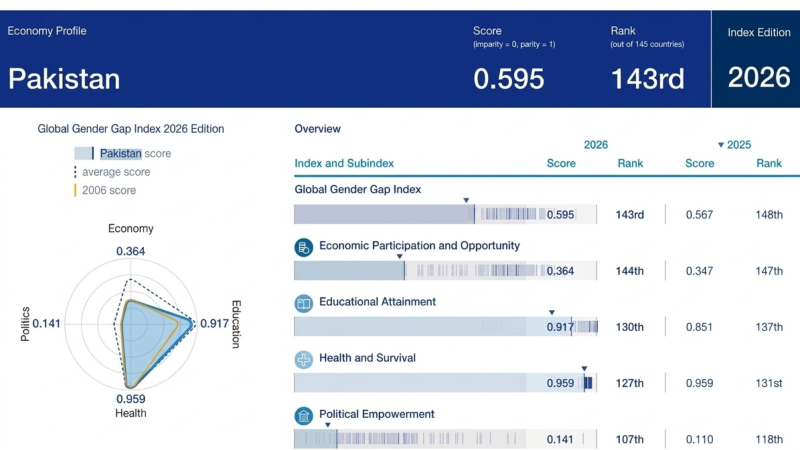
Pakistan has ranked 143rd out of 145 economies in the World Economic Forum’s (WEF) Global Gender Gap Report 2026, placing the country third from the bottom despite recording its strongest year-on-year improvement in a decade.
The 20th edition of the Global Gender Gap Report, released on September 16, measures the state and evolution of gender parity across four key dimensions: economic participation and opportunity, educational attainment, health and survival, and political empowerment.
Pakistan recorded an overall gender parity score of 59.5 per cent in 2026, an improvement of 2.8 percentage points from the previous year. Its ranking also improved by five places compared with 2025. However, Pakistan remained among the lowest-performing economies globally and ranked last among the 38 lower-middle-income economies and the seven South Asian economies covered by the index.
The WEF report noted that Pakistan has narrowed its gender gap by 5.2 percentage points since 2006, when its parity score stood at 54.3 per cent. The latest edition, it said, represents the country's strongest annual improvement in a decade, driven primarily by gains in educational attainment.
Education emerged as Pakistan's strongest area of improvement. The country recorded a gender parity score of 91.7 per cent in educational attainment, its highest score on the measure and more than six percentage points higher than the previous edition. Since 2006, Pakistan's educational parity score has risen from 70.6 per cent to 91.7 per cent, with improvements recorded across primary, secondary and tertiary enrolment.
Economic participation and opportunity, however, remained the country's weakest-performing dimension. Pakistan ranked 144th globally in this category, with a parity score of 36.4 per cent. The WEF identified economic participation as the principal constraint on Pakistan's overall gender parity.
The report found that women's labour-force participation remained substantially below men's, while women also remained underrepresented in senior decision-making positions. Women accounted for only 6.5 per cent of legislators, senior officials and managers, although the figure has increased significantly over time. Estimated earned-income parity stood at just 26.3 per cent and has declined over the past two decades.
Pakistan performed comparatively better in health and survival, where it recorded a parity score of 95.9 per cent. Political empowerment, meanwhile, stood at 14.1 per cent, placing Pakistan 107th globally in the subindex. The report recorded increases in women's representation at parliamentary and ministerial levels, although both indicators remained far from full parity.
Iceland retained the top position globally, followed by Finland and Norway. At the bottom of the 2026 ranking were the Democratic Republic of Congo, Chad, Iran, Pakistan and Algeria.
The WEF said that, despite two decades of progress, full global gender parity remains distant. Based on the historical rate of progress, the report estimates that achieving global parity across all measured dimensions would still take 120 years.