
WEBDESK - NAYADAUR
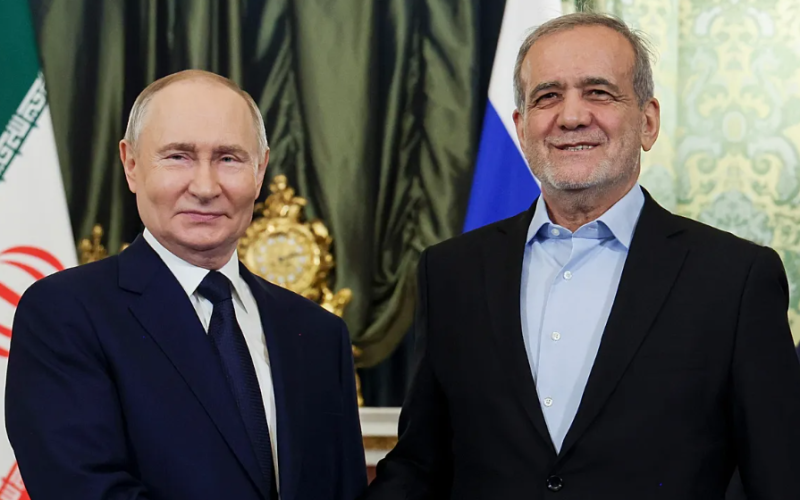
Russian President Vladimir Putin and Iranian President Masoud Pezeshkian have arrived in India ahead of the 2026 BRICS summit, where war, global trade disruption, energy security and the future of the expanded economic bloc are expected to dominate discussions.
The two-day summit begins Saturday, with Chinese President Xi Jinping also expected to arrive in New Delhi. The meeting brings together leaders and senior officials from an expanded 11-member BRICS grouping that includes major emerging economies seeking greater influence in international institutions traditionally dominated by Western powers.
For India, the summit presents a particularly delicate diplomatic challenge. The gathering will bring together Russia, Iran, Saudi Arabia and the United Arab Emirates at a time of heightened tensions surrounding the Middle East, while the war in Ukraine continues to reshape global energy and trade flows.
Putin is expected to hold talks with Indian Prime Minister Narendra Modi after arriving in New Delhi. Moscow remains one of New Delhi’s most important strategic partners, and Russia has also become a significant energy source for India as the global energy market faces disruption from conflicts and sanctions.
Modi has also called for an end to the war in Ukraine. India has sought to maintain close ties with Moscow while simultaneously strengthening relations with Western countries and supporting diplomatic efforts to end the conflict.
Pezeshkian’s attendance will place the Middle East conflict at the center of the summit’s diplomatic agenda. It will be his first visit to India as Iran’s president and comes as Tehran’s relations with the United States and Israel remain a major source of regional instability.
The presence of Saudi Arabia and the UAE further complicates the diplomatic equation. While all three countries are members of the expanded BRICS framework, they have different strategic interests and positions concerning the regional conflict.
Analysts expect the Gulf conflict to become a major test for the group’s ability to maintain unity.
“The Gulf conflict is going to be the central fault line this time during the BRICS summit,” said Harsh V. Pant, a professor of international relations and vice president of India’s Observer Research Foundation.
Pant said BRICS’ expansion, once viewed as an achievement, could now become a constraint due to divergent interests among its members.
Trade is another major issue confronting the summit. BRICS was originally established as a platform for emerging economies seeking a stronger voice in global economic governance, but its expansion has increased the diversity of economic and geopolitical interests represented within the group.
The summit is also significant for relations between India and China. Xi’s visit will be his first to India since 2019 and marks another step in a cautious improvement in relations between the two nuclear-armed neighbors following years of tensions along their disputed Himalayan border.
Flights, visas and high-level diplomatic contacts have gradually resumed, although mistrust remains over the border, trade imbalances and wider strategic competition.
India is also attempting to balance its relations with Iran, Israel, Russia and the United States, making the BRICS summit an important test of New Delhi’s increasingly complex foreign policy.
The meeting is expected to highlight whether the expanded BRICS can reconcile its members’ competing economic and geopolitical priorities while presenting a coherent position on global trade, energy and major conflicts.