
WEBDESK - NAYADAUR
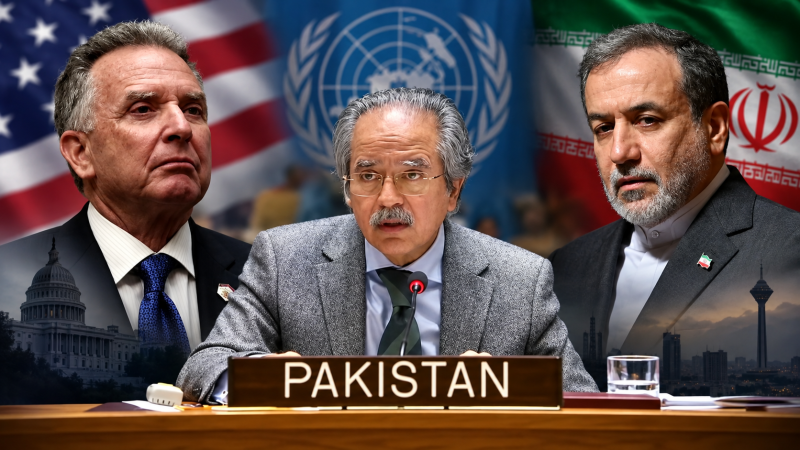
Pakistan is urging Washington and Tehran to resume negotiations under an Islamabad-brokered framework as renewed attacks threaten regional stability and tensions persist over the Strait of Hormuz.
Pakistan is pressing the United States and Iran to return to negotiations despite renewed strikes and the failure to implement an agreement brokered by Islamabad, the country’s ambassador to the United Nations said.
Asim Iftikhar Ahmad, Pakistan’s permanent representative to the UN, said Islamabad continues to maintain high-level communication with both Washington and Tehran and believes diplomacy remains the most viable route toward a lasting resolution.
“There is this lingering lack of trust on both sides,” Ahmad told The National, explaining why the Islamabad Memorandum of Understanding has not been fully implemented. He added that there was also “a slight lack of willingness” to move ahead with the agreement, but said Pakistan was continuing its diplomatic efforts.
Tensions between Iran and the US have escalated again following a period of relative calm, with renewed attacks and continued uncertainty surrounding the strategically important Strait of Hormuz.
Pakistan has increasingly positioned itself as a mediator, working with regional and international partners including Saudi Arabia, Egypt, Turkey, China and Qatar.
“We have open lines of communication with both parties, with both Iran and the US, and at high levels,” Ahmad said.
He argued that the framework created through Pakistan’s mediation provides a basis for renewed talks.
“We believe that the best way to resolve the situation and to conclude a comprehensive and conclusive deal is to return to the negotiations table,” he said.
Pakistan is serving its final year of a two-year elected term on the UN Security Council, giving Islamabad a direct role in discussions on international peace and security.
Ahmad said Pakistan’s previous mediation efforts demonstrated that negotiations were possible even during periods of intense fighting. He pointed to an earlier ceasefire reached amid heavy escalation as evidence that the two sides could be brought together again.
He declined to assign greater responsibility to either Washington or Tehran for the failure to resume talks, saying the situation was more complicated than identifying which side was unwilling to negotiate.
Pakistan Calls for Stronger Action on Gaza
Ahmad also criticized the deteriorating situation in Gaza and the occupied West Bank, warning that Israeli policies are undermining prospects for a two-state solution.
He said the Gaza ceasefire was not being fully respected and alleged that continued violations had resulted in hundreds of deaths since the ceasefire was announced.
The ambassador also pointed to settlement expansion and settler violence in the West Bank, saying such developments were moving the region further away from the possibility of Palestinian statehood.
He called on the UN and the international community to take a stronger position in support of Palestinian self-determination and an end to the occupation.
“Ending the occupation eventually is the only viable way for a durable peace in the region,” Ahmad said.
Pakistan Backs UN Security Council Reform
On reform of the UN Security Council, Ahmad criticized the influence of the five permanent members — Britain, China, France, Russia and the United States — and their ability to veto resolutions.
Pakistan opposes adding more permanent seats, arguing that this could worsen existing problems.
Instead, Islamabad supports expanding the number of elected, non-permanent members, which Ahmad said would make the council more representative and give greater influence to countries accountable to the wider General Assembly.
Ahmad Named Pakistan’s Next Foreign Secretary
In a significant development, Ahmad learned immediately after his interview with The National that he had been appointed Pakistan’s next foreign secretary.
Deputy Prime Minister and Foreign Minister Ishaq Dar announced the appointment on Sept. 9, naming Ahmad as the successor to Amna Baloch, who is due to retire from government service on Sept. 17.
Ahmad will leave his position as Pakistan’s permanent representative to the UN at the end of September and become the country’s 34th foreign secretary.
His appointment comes as Pakistan seeks to strengthen its diplomatic role in regional conflicts, including the confrontation between Iran and the United States.