
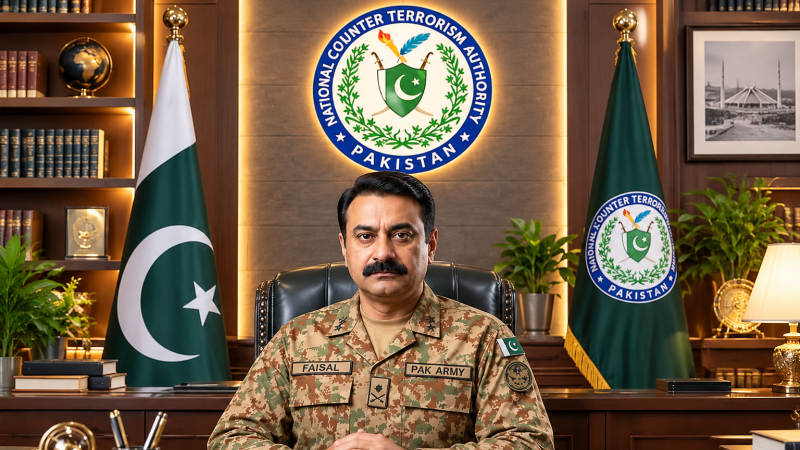
ISLAMABAD: Major General Faisal Naseer, a senior Inter-Services Intelligence (ISI) official, has been appointed National Coordinator of the National Counter Terrorism Authority (NACTA) for a three-year term, marking a departure from the authority’s traditional leadership pattern.
According to a notification issued by the Establishment Division on Friday, Maj Gen Naseer has been appointed on a secondment basis under Section 9(1) of the NACTA Act, 2013, with the approval of the federal government. The appointment is effective immediately and will remain in force until further orders. Maj Gen Naseer was serving as Director General (Counter-Intelligence) at ISI, a position he assumed in 2022 after his promotion to the rank of major general.
Established in 2008 under the Ministry of Interior, NACTA was subsequently given a statutory framework through the NACTA Act, 2013. Its mandate includes developing comprehensive national strategies and action plans against terrorism and extremism, coordinating their implementation and reporting progress to the federal government. It was also assigned a role in implementing the 20-point National Action Plan formulated after the 2014 Army Public School attack.
The appointment comes as Pakistan continues to face persistent security challenges, particularly in Khyber Pakhtunkhwa and Balochistan, increasing the importance of effective coordination between intelligence agencies, law-enforcement bodies and federal and provincial administrations.
NACTA, however, has historically faced questions over its institutional capacity and authority. Despite being conceived as a central coordinating body for national counter-terrorism policy, it has often struggled to translate its mandate into effective coordination across Pakistan’s security and law-enforcement architecture.
Maj Gen Naseer’s three-year tenure could therefore provide NACTA with greater continuity and strategic experience. The larger question is whether his appointment will be accompanied by stronger institutional authority, adequate resources and more effective mechanisms for coordination with intelligence and law-enforcement agencies.