
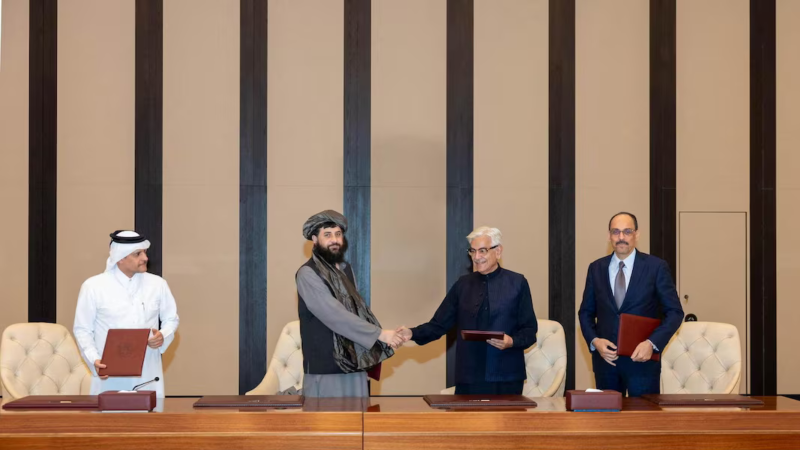
Pakistan and the Afghan Taliban began a third round of negotiations in Istanbul on Thursday, seeking to stabilise a shaky ceasefire and address Islamabad’s longstanding concerns over cross-border militancy. The talks, mediated by Turkiye and Qatar, come after last month’s deadly border clashes briefly pushed relations between the neighbours to their lowest point since the Taliban returned to power in Kabul in 2021.
Pakistan’s delegation is led by Lt Gen Asim Malik, Director General of the Inter-Services Intelligence (ISI), alongside senior officials from the military, intelligence agencies and the Foreign Office. The Afghan side is headed by Abdul Haq Waseq, chief of the General Directorate of Intelligence, and includes senior Taliban officials, including deputy interior minister Rehmatullah Najib and spokesperson Suhail Shaheen.
The latest dialogue follows earlier meetings in Doha and Istanbul, where both sides agreed in principle to uphold a ceasefire and develop a “monitoring and verification mechanism” to prevent future hostilities. However, details of enforcement and penalties for violations remain unresolved.
Islamabad maintains that its core demand is non-negotiable: Afghan territory must not be used for attacks against Pakistan. “The Pakistan military and intelligence service have a single-point agenda — the end of terrorism,” military spokesperson Lt Gen Ahmed Sharif said earlier this week. Pakistani officials insist they require verifiable assurances from Kabul that groups such as the Tehreek-i-Taliban Pakistan (TTP) will not operate from Afghan territory.
The Taliban deny harbouring militants and have accused Pakistan of carrying out airstrikes inside Afghanistan — a charge Islamabad has neither confirmed nor publicly addressed.
Tensions escalated after armed attacks on Pakistani border posts in mid-October triggered retaliatory strikes, resulting in casualties on both sides. A temporary truce was brokered on October 15, eventually leading to the current dialogue.
Officials in both capitals remain cautious. Pakistani Defence Minister Khawaja Asif has warned that progress depends on Kabul’s “wisdom” and willingness to act. “If there is no possibility of progress,” he said, “then it is a waste of time.”