
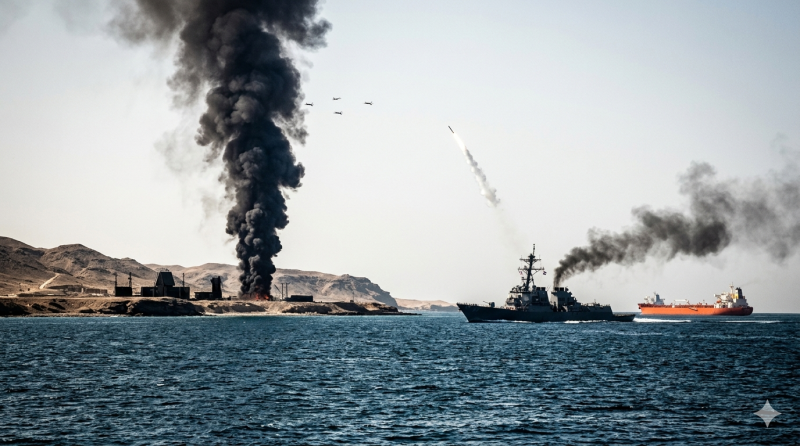
The United States and Iran have exchanged fresh strikes across the Gulf region, sharply raising tensions and putting at risk a fragile ceasefire that has been in place since 8 April. The escalation follows nearly 100 days of conflict triggered by earlier US and Israeli strikes on Iran’s senior leadership, with renewed drone and missile activity now centred on the Strait of Hormuz.
Drone movements near the Strait prompted US forces to respond with strikes on Iranian coastal radar installations in Goruk and on Qeshm Island. The US Central Command said the sites were targeted after four drones were intercepted, which it described as posing an “immediate threat” to regional maritime traffic and commercial shipping lanes.
In retaliation, Iran’s Islamic Revolutionary Guards Corps launched seven ballistic missiles towards Kuwait and Bahrain, claiming it was targeting “enemy bases” in response to what it called a US “invasion” of Iranian territory. US officials said six missiles were intercepted, while the seventh failed to reach its intended target, with no confirmed US casualties.
Kuwaiti authorities reported active air defence operations as drones and missiles entered its airspace, while reports of explosions were also heard in parts of the Gulf. Washington rejected Iranian claims of damage to US facilities, insisting that its regional military infrastructure, including the Fifth Fleet headquarters in Bahrain, remained unaffected.
Despite the military escalation, diplomatic contradictions continued. US President Donald Trump said Iran still retained around 21 to 22 per cent of its missile stockpile, suggesting its capabilities had not been fully degraded. At the same time, Washington confirmed visa approvals for Iran’s national football team to attend the upcoming FIFA World Cup in North America.
Regional political tensions also intensified alongside the fighting. Lebanon urged Iran to stop interfering in its internal affairs amid spillover from the wider conflict, warning against turning the country into a battleground. Iran rejected the criticism and insisted that developments in Lebanon and the Gulf are interconnected, while negotiations between Washington and Tehran remain deadlocked.