
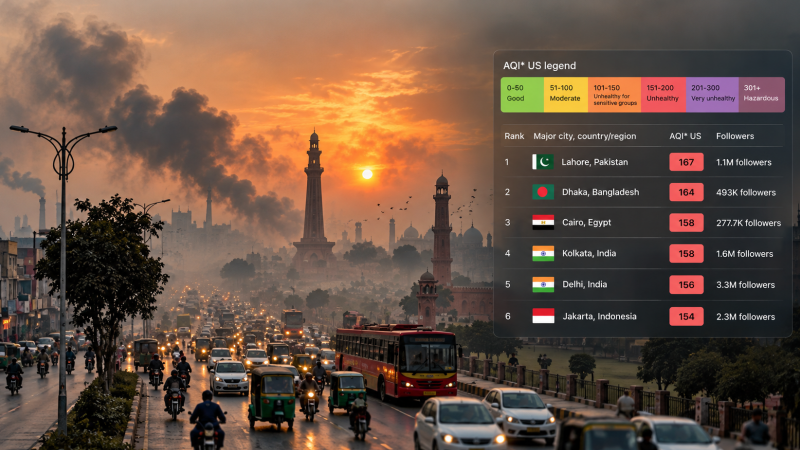
Lahore once again emerged as the world’s most polluted major city, with its air quality reaching the “unhealthy” category, according to air quality monitoring platform IQAir.
The provincial capital recorded an Air Quality Index (AQI) of 167 on IQAir’s global ranking during the morning, placing it among the cities with the poorest air quality worldwide. The ranking fluctuated during the day as weather conditions changed, highlighting the rapidly shifting nature of Lahore’s air pollution.
IQAir data showed that fine particulate matter, or PM2.5, remained a major concern in the city. At one point, Lahore’s PM2.5 concentration was reported at more than 15 times the World Health Organization’s annual guideline value. These microscopic particles can penetrate deep into the respiratory system and are associated with significant health risks when exposure is prolonged.
The Punjab Environmental Protection Agency’s monitoring system also recorded elevated pollution levels across several parts of Lahore. Several monitoring stations reported AQI readings in the unhealthy range, reflecting widespread deterioration in air quality across the city.
Air pollution in Lahore is linked to a combination of factors, including vehicle emissions, industrial activity, crop-residue burning, road dust and atmospheric conditions that prevent pollutants from dispersing. Punjab authorities have intensified anti-smog measures across the city in response to deteriorating air quality. According to officials, water bowsers and sprayers have been deployed at pollution hotspots to suppress road dust, while smog guns, drone squads, night teams and monitoring teams are being used to identify and respond to pollution sources.
Environmental authorities have also inspected industrial units and brick kilns, with action taken against facilities found violating environmental regulations. Officials have further intensified measures against crop-residue burning and encouraged farmers to use machinery such as Super Seeders to manage agricultural waste without setting it on fire.
The latest pollution episode has renewed concerns about Lahore’s recurring air-quality crisis as the region enters the period when smog traditionally becomes more severe. Health experts have repeatedly advised residents to reduce prolonged outdoor activity when pollution levels are high and take precautions against exposure to polluted air.
Lahore’s repeated appearance near the top of global pollution rankings has placed renewed focus on the need for sustained measures addressing emissions from transport, industry, agriculture and other sources contributing to the city’s deteriorating air quality.