
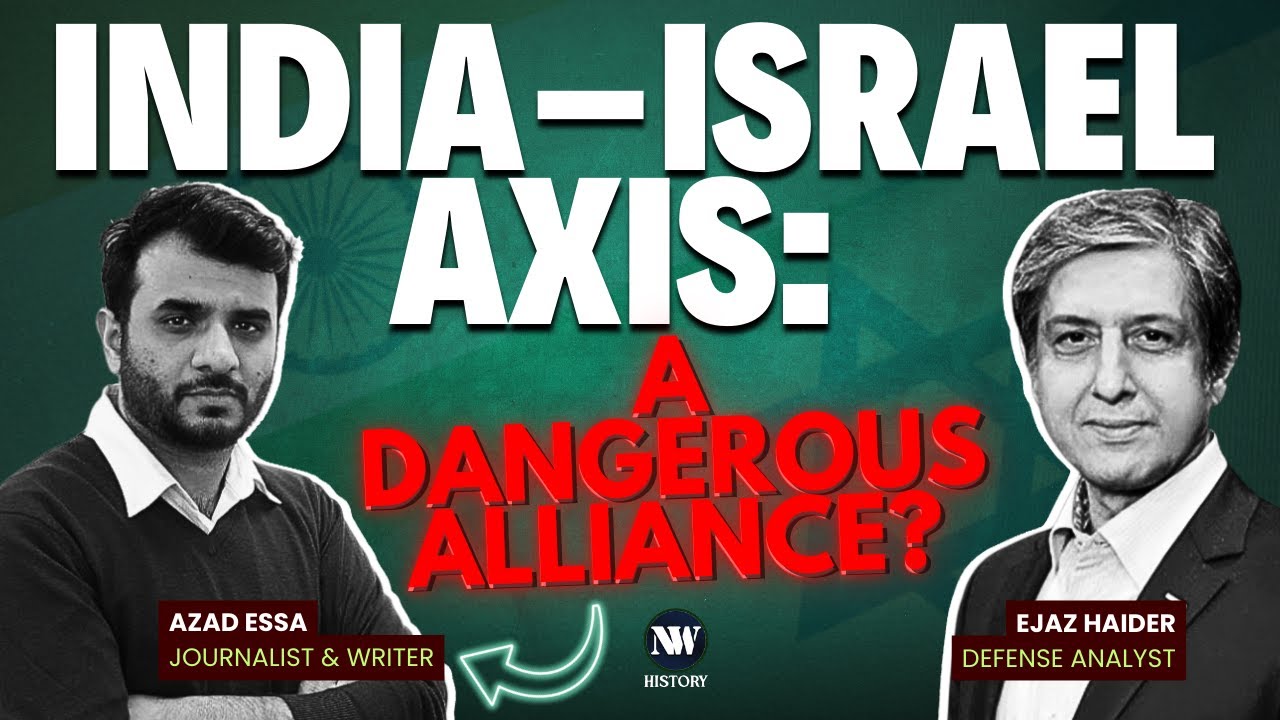
A new strategic alignment between India and Israel is reshaping geopolitics far beyond their immediate neighbourhoods. Though geographically distant, the two states are increasingly bound by shared ideology, security practices and political narratives, an alliance that carries profound implications for South Asia, the Middle East and the global order.
These themes took centre stage in a wide-ranging conversation between award-winning journalist and author Azad Essa and senior defence analyst Ejaz Haider, centred on Essa’s book "Hostile Homelands: The New Alliance Between India & Israel" examining the India–Israel relationship. Far from a transactional partnership based solely on arms sales or diplomacy, Essa argues that the alliance is deeply ideological, rooted in the theological and political affinities between Hindutva and Zionism.
Challenging the long-held perception of India as a principled supporter of Palestine, Essa dismantles what he describes as a myth of moral consistency. India’s historical posture, he contends, was shaped less by solidarity and more by Cold War pragmatism, energy dependencies and anxieties about legitimising partition, particularly Pakistan’s creation. Behind public rhetoric, covert military and intelligence cooperation with Israel persisted for decades.
While the relationship became openly visible under Prime Minister Narendra Modi, Essa stresses that it was nurtured well before him. Congress-era governments laid the groundwork through arms purchases, intelligence ties and diplomatic engagement. Modi, he suggests, merely removed the remaining inhibitions, allowing an already robust partnership to operate in full view.
At the heart of the alliance lies a shared worldview that prioritises securitisation over rights. From surveillance technologies to counterinsurgency tactics, India has increasingly drawn on Israeli models, most visibly in occupied Kashmir. Essa stops short of equating Kashmir and Palestine, but highlights striking similarities in methods: demographic engineering, legal exceptionalism and the recasting of political struggles as issues of law and order.
The discussion also situates the alliance within a wider transnational ecosystem involving the United States and Gulf states, particularly the UAE, which has helped normalise India–Israel ties through economic corridors, capital flows and strategic cover.
Ultimately, Essa’s intervention is not simply about foreign policy. It is a warning about how ideology, when fused with militarisation and unchecked power, can normalise repression, at home and abroad.