
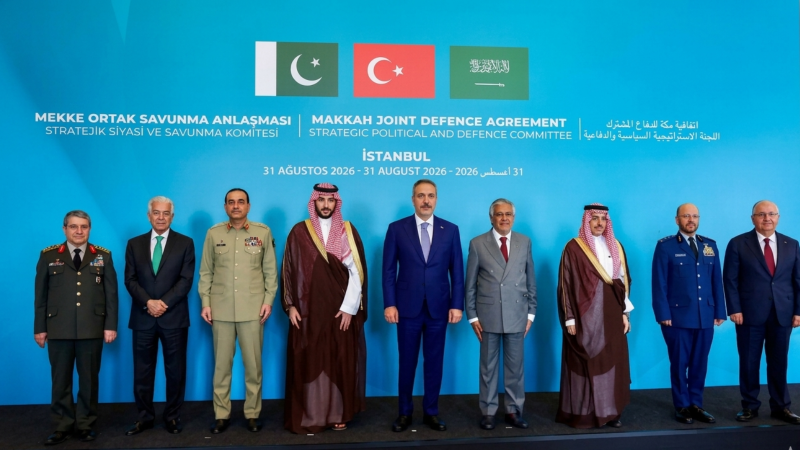
Pakistan, Saudi Arabia and Turkiye on Monday held the inaugural meeting of the Strategic Political and Defence Committee under the Makkah Joint Defence Agreement, marking the first formal step towards trilateral defence arrangement.
The high-level meeting in Istanbul was attended by Pakistan’s Deputy Prime Minister and Foreign Minister Ishaq Dar, Defence Minister Khawaja Asif and Chief of Defence Forces Field Marshal Asim Munir. Turkiye was represented by Foreign Minister Hakan Fidan, Defence Minister Yasar Guler and Chief of the General Staff General Selcuk Bayraktaroglu, while Saudi Arabia also sent its foreign, defence and military leadership.
Fidan said the tripartite arrangement would be known as the "Makkah Defence Alliance", while announcing that its first secretary general would be a Pakistani national. The alliance’s secretariat will be based in Saudi Arabia and will initially be headed by Pakistan for a three-year term.
The institutional structure represents an important development since Pakistan, Saudi Arabia and Turkiye signed the Makkah Joint Defence Agreement on August 7. The agreement commits the three countries to treat an armed attack against one member as an attack against all, establishing a framework for collective deterrence and defence cooperation.
The Istanbul meeting focused on translating the political commitment into practical mechanisms. Discussions covered military interoperability, defence capabilities, cooperation in defence technology and production, and closer coordination among the three countries’ armed forces.
The alliance is also emerging amid heightened regional tensions and uncertainty over the future security architecture of the Middle East. Analysts have noted that the pact could provide its members with greater strategic autonomy while allowing them to diversify their security partnerships. However, questions remain over how the alliance will operate in practice and how far its collective-defence commitment will extend during a major regional conflict.