
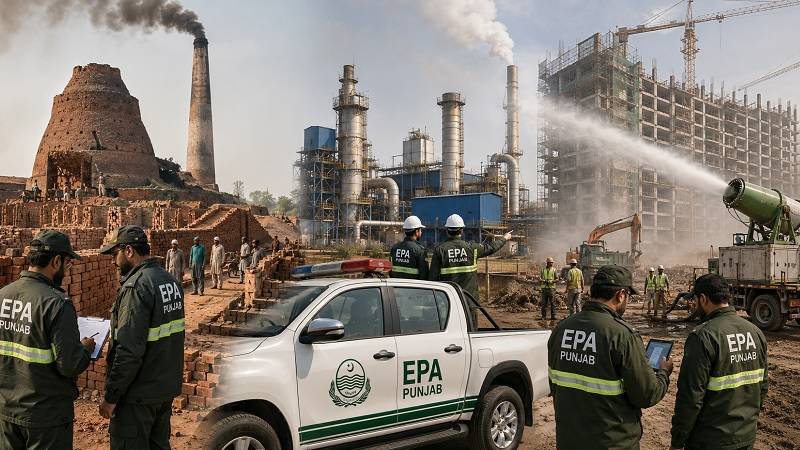
The Environment Protection Agency (EPA) Punjab has launched an intensified province-wide enforcement campaign targeting brick kilns, industrial units, plastic manufacturers, construction sites and other major sources of pollution as part of its preparations for the upcoming winter smog season.
The initiative was reviewed during a pre-smog preparedness meeting chaired by Director General EPA Punjab Syed Musa Raza, who met directors of all EPA directorates and field officers from across the province to assess district-wise preparedness, enforcement strategies and compliance targets.
During the meeting, Raza directed all regional offices to accelerate enforcement operations, strengthen field monitoring and ensure strict implementation of environmental laws to curb emissions before the onset of smog.
He emphasised that all enforcement wings should work in close coordination and adopt a zero-tolerance policy towards environmental violations, saying preventive measures before winter would be more effective than reactive interventions during peak smog months.
Following the meeting, the DG inspected brick kilns in different districts to review compliance with environmental regulations. He instructed field officers to take indiscriminate action against illegal and highly polluting brick kilns, ensure the use of approved zigzag technology and initiate legal proceedings against violators without delay.
He described brick kilns as one of the major contributors to winter air pollution and said their strict regulation was essential to improving air quality.
Earlier, Raza also visited the Fog Cannon Machines site and directed operational teams to ensure uninterrupted functioning of fog cannons at major under-construction sites. He instructed field formations to deploy anti-smog guns wherever particulate pollution levels increase, particularly in areas where the Air Quality Index (AQI) exceeds permissible limits based on real-time monitoring by EPA Punjab Laboratories and the Climate Watch Hub.
He further directed construction companies to implement effective dust suppression measures, including continuous operation of mist sprinklers and anti-smog guns, especially during dry and windy conditions.
The DG also ordered industrial units to keep pollution control and filtration systems fully operational, warning that industries bypassing or operating without functional emission control equipment would face sealing, prosecution and financial penalties under environmental laws.
In addition, enforcement teams have been instructed to intensify inspections of heavy transport vehicles at city entry and exit points. Special squads will conduct emissions testing of commercial and freight vehicles and take legal action against those exceeding prescribed emission standards.
According to EPA Punjab enforcement data covering the period from January 1 to July 25, 2026, brick kilns remained the primary focus of enforcement activities. Authorities inspected 45,736 brick kilns, demolished 777, sealed 419, registered 762 FIRs and imposed fines amounting to Rs67.76 million.
Industrial units formed the second-largest category of enforcement. EPA teams inspected 27,384 industrial units, sealed 694, demolished 272, registered 175 FIRs and imposed fines worth Rs123 million.
As part of the campaign against plastic pollution, officials carried out 18,293 inspections, issued 1,989 notices, confiscated 229,713 prohibited plastic items, registered 66 FIRs, sealed 2,725 premises and imposed fines totalling Rs22.973 million.
To reduce dust emissions, EPA teams inspected 336 construction sites, issued 249 notices and sealed 16 sites. The agency said 173 construction sites had installed and were operating mist sprinkler systems.
The EPA also inspected 316 industrial units for the installation of suction hood systems aimed at reducing industrial air pollution. It found 165 units compliant, while 95 units were sealed for failing to meet the requirements.
Under its water pollution control campaign, the agency inspected 744 facilities, issued 31 notices, sealed 43 units, registered two FIRs and imposed Rs1 million in fines. Officials also confirmed that 69 wastewater treatment plants had been installed and were operational.
Vehicle emissions monitoring covered 3,930 vehicles during the reporting period, with 13 failing emissions standards.
Meanwhile, EPA teams inspected 1,318 sand trolleys, finding 1,305 compliant with standard operating procedures, while 13 were rejected or returned for failing to meet prescribed requirements.
Speaking after the inspections, Raza said the Punjab government was pursuing a proactive, science-based strategy to tackle smog through continuous monitoring, modern enforcement techniques and coordinated field operations.
"Every regional office has been assigned clear targets for the pre-smog campaign. Enforcement teams will remain active in the field, while decisions will be guided by real-time environmental monitoring data. Industries must operate effective emission control systems, construction sites must implement dust suppression measures and smoke-emitting vehicles will not be allowed to enter urban centres unchecked," he said.
He added that the EPA would continue strengthening coordination with district administrations and enforcement agencies to improve environmental compliance and air quality across Punjab ahead of the winter smog season.