
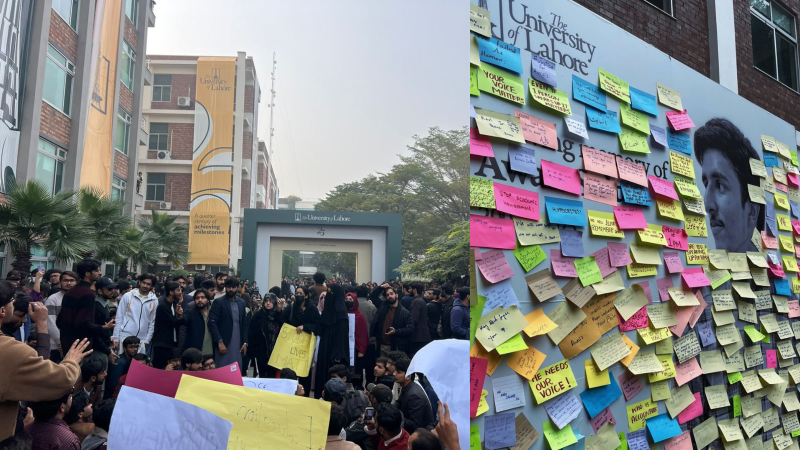
Following the tragic death of Awais Sultan, students of the University of Lahore organised a peaceful protest on Monday at the university campus to express grief and demand transparency. The demonstration remained orderly throughout, with students calling for institutional accountability and stronger support mechanisms for student welfare.
In a notable gesture aimed at de-escalation and engagement, Chairman UOL Awais Raoof and members of the Board of Governors were present among the protesting students. University officials were seen interacting with demonstrators, listening to their concerns, and assuring them that the administration would address legitimate grievances through proper channels.
The students demanded the carrying out of an independent & transparent inquiry, termination of complicit individuals, revised attendance policies, and free medical & mental health facilities for all students. +#PSC #Lahore #UoL #Students pic.twitter.com/Nf2Xc88VDq
— Progressive Students’ Collective (@PSCollective_) December 22, 2025
As part of the official response, the University of Lahore arranged a ghaibana namaz-e-janaza in the university lawn, attended by students, faculty members, and administrative staff. The university also announced the formation of a grievance committee tasked with engaging students, reviewing concerns related to campus life, and recommending corrective measures where necessary.
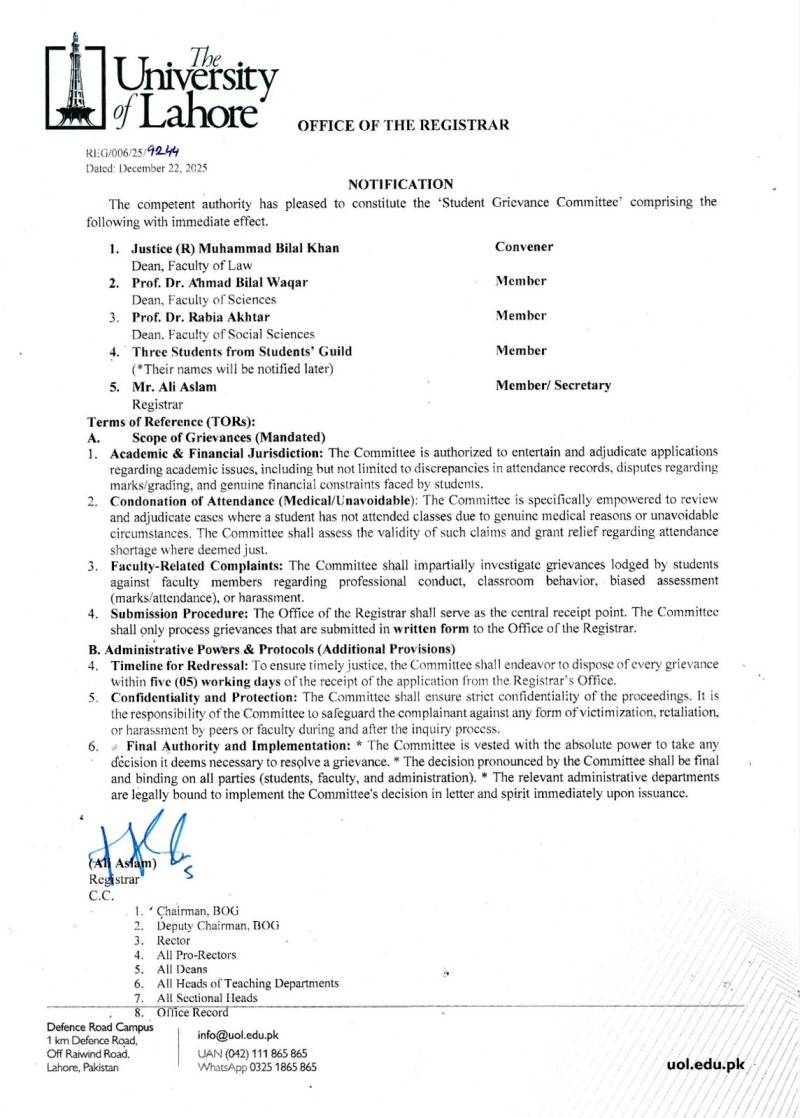
In addition, the university has established a dedicated student mental health helpline to provide immediate psychological support. Officials said that improvements have also been introduced at the existing mental health centre, with steps taken to enhance counselling services and expand access for students. The administration further stated that an in-depth investigation into the incident is underway to ensure clarity, transparency, and accountability.
According to university officials, the protest concluded peacefully after students were assured that their demands would be formally recorded and addressed. No untoward incidents were reported during the demonstration.
Meanwhile, misinformation and unverified claims circulating on social media have contributed to heightened public emotions around the incident, risking confusion and distortion of facts. However, based on available information and a review of preliminary findings, the cause of Awais Sultan’s suicide appears to be personal and non-academic in nature, with no evidence so far linking the incident to university policies or administrative actions.
At the same time, the situation has underscored the importance of responsible reporting and restraint in online discourse, particularly during moments of grief. The episode has prompted renewed discussion around student well-being, institutional engagement, and the need for transparent mechanisms to address concerns without fuelling speculation or public outrage.