
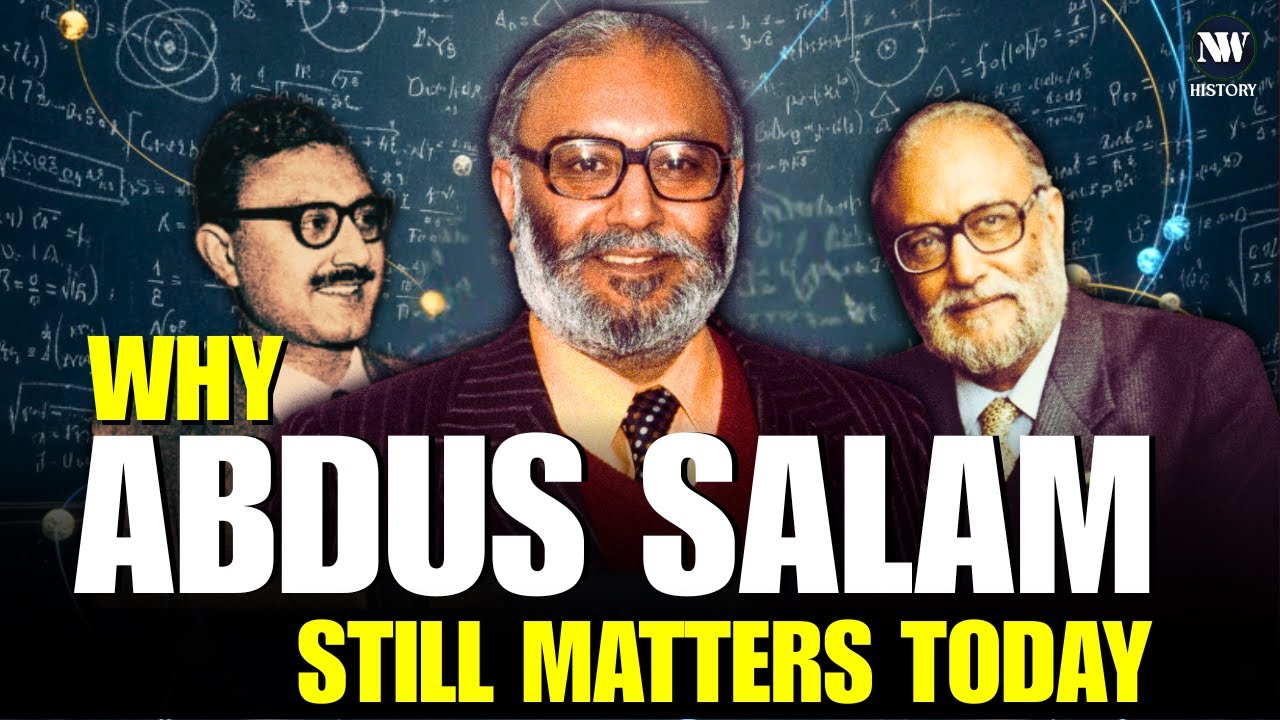
Born in 1926 in the rural town of Jhang in Punjab, Abdus Salam’s journey from modest beginnings to the pinnacle of global science stands as one of Pakistan’s most remarkable intellectual stories. The son of a schoolteacher from an Ahmadi Muslim family, Salam displayed extraordinary academic ability from an early age. By the age of fourteen, he had topped his province in examinations, earning a scholarship to Government College, Lahore, and later securing a place at Cambridge University.
At Cambridge, Salam distinguished himself in mathematics and physics, quickly gaining recognition for solving complex problems in quantum field theory that had challenged even leading physicists of the time. His brilliance earned him the prestigious Adams Prize and brought him to the attention of figures such as Hans Bethe and Robert Oppenheimer. By 1957, Salam was leading a theoretical physics group at Imperial College London.
His most enduring contribution came in the 1960s with the formulation of the electroweak theory, which unified electromagnetism and the weak nuclear force. This breakthrough predicted the existence of the W and Z bosons, particles later discovered at CERN in 1983. For this achievement, Salam was awarded the 1979 Nobel Prize in Physics alongside Sheldon Glashow and Steven Weinberg, becoming the first Pakistani and the first Muslim scientist to receive a Nobel Prize in the sciences.
Beyond this landmark work, Salam made influential contributions to grand unified theories, supersymmetry, neutrino physics, and astrophysics. His ideas became central to the Standard Model of particle physics, shaping modern understanding of the universe’s fundamental forces.
Salam’s life was not without hardship. In 1974, following Pakistan’s constitutional amendment declaring Ahmadis non-Muslim, he left the country in protest and spent the remainder of his life abroad. Despite this, he continued to support Pakistan’s scientific development, donating much of his Nobel Prize money to fund young scientists.
A passionate advocate for global scientific equality, Salam founded the International Centre for Theoretical Physics (ICTP) in Trieste in 1964, providing scholars from developing countries access to world-class research. He later helped establish the World Academy of Sciences (TWAS), amplifying the voices of scientists from the Global South.
Knighted by Britain and honoured internationally, Abdus Salam passed away in 1996. Today, his legacy endures through his theories, institutions, and the generations of scientists he inspired—proving that intellectual excellence can transcend borders, prejudice, and circumstance.