
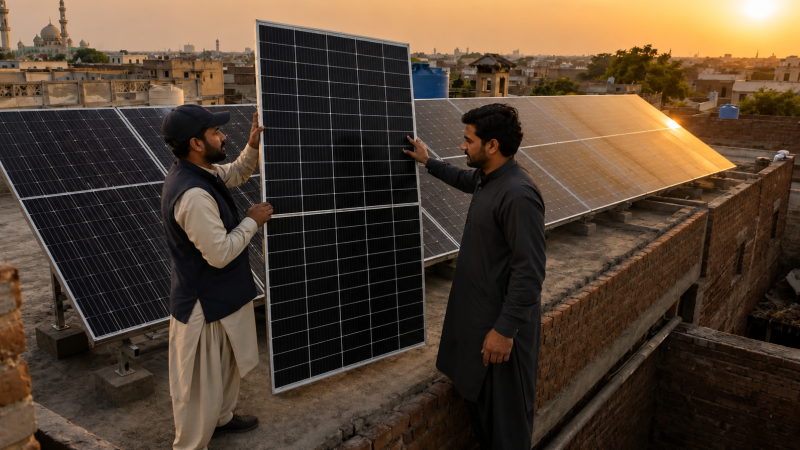
Pakistan’s solar market has expanded on the promise of cheaper electricity, but a major manufacturing shift in China is creating a new question for buyers: what happens when panels being offered at a discount are already moving out of the production mainstream?
China’s mandatory national standard GB 47834-2026, published in June 2026 and effective from January 1, 2027, introduces minimum conversion-efficiency requirements for crystalline-silicon photovoltaic modules. The Grade 3 floor is 23.2 percent for TOPCon and HJT modules and 23.5 percent for BC modules.
Although the policy is written in terms of efficiency rather than wattage, its implications for the 585W products commonly found in Pakistan are significant. Mainstream 585W modules in the market generally sit around 21 to 22.6 percent efficiency, below the new minimum thresholds. In practical market terms, that places the prevailing 585W category on a phase-out path as manufacturers shift production towards compliant products. That transition matters well beyond China.
Under Chinese standardisation law, products that do not meet mandatory standards cannot be produced, sold or imported for the domestic Chinese market. Pakistan should therefore be cautious about becoming an outlet for modules that are losing acceptance in the very market where they are manufactured. If a product is being pushed out of mainstream production because it no longer meets the latest efficiency benchmark, an unusually low export price should be treated as a warning sign rather than an automatic bargain. The immediate concern is leftover inventory.
As production shifts, existing 585W stocks will not disappear overnight. They can continue moving through distribution and export channels, with price-sensitive markets becoming natural destinations for clearance inventory. Pakistan already holds sizeable imported solar-panel inventories, making this transition particularly relevant for local consumers.
For buyers, the temptation is obvious: lower upfront cost and a familiar wattage at a time when affordability remains central to solar adoption.
But solar panels are long-term investment assets, not short-lived consumer goods. Once a model leaves active production, its value can depreciate faster, identical replacement stock becomes harder to source and after-sales service can become more complicated. What looks like a saving today may therefore represent a longer-term product risk for the buyer. This is where warranty risk becomes important.
A vendor may still offer a warranty, but a warranty on paper does not guarantee that the same module will be readily available several years later. Solar panels operate as part of an integrated system, and replacing one failed module can require matching electrical characteristics, dimensions and mounting configuration. If compatible stock is no longer manufactured, a simple replacement can turn into system modification, additional labour, transport costs and extended downtime.
For a household, that may mean greater reliance on grid electricity. For a business, downtime can raise operating expenses. For a farmer running a solar-powered tube well, delayed repair can disrupt irrigation, working hours and ultimately crop income. That is the real danger of the “low upfront cost, high long-term cost” trap.
The lesson for Pakistan is not that every discounted panel is defective. It is that buyers need to distinguish between a product that is cheap because solar technology is becoming more affordable and one that is cheap because it is being cleared from an ageing generation.
As 2027 approaches, 585W modules deserve much closer scrutiny. If products are being pushed out of mainstream sale and production in their manufacturing market under tougher efficiency rules, Pakistan should ask whether clearing that older inventory into its own market truly serves consumers. A clearance price may save money today. The cost of owning an increasingly unsupported product can last much longer.