
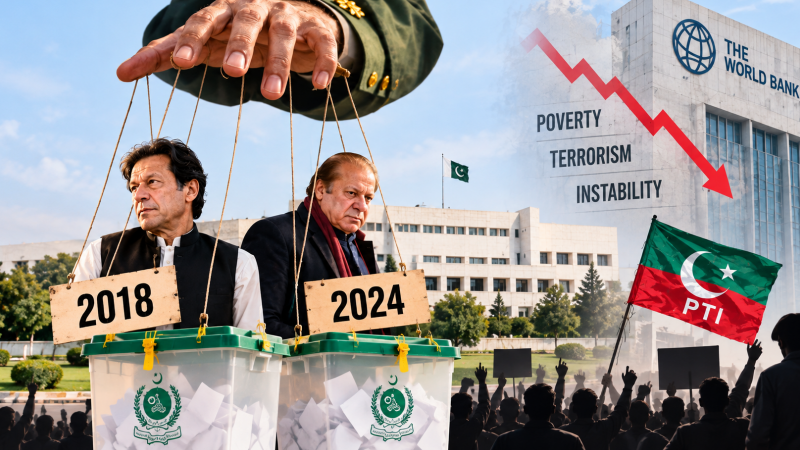
Pakistan has been an experimental laboratory for the establishment since its creation. It has been a long journey of experiments to impose hybrid regimes on the country by the powerful establishment in the hope of gaining full control over power and resources.
Elections in the country have always been conducted in favour of the establishment’s preferred political party, and every single election has had a question mark over its credibility. Every dictator, or whoever has been at the helm of the establishment, has tried to invent new ways of bringing their own favourite political party to power. As a result, the country is merely moving in circles instead of moving forward.
Look at the two most recent general elections. In 2018, Imran Khan came to power with the help of the establishment after a rigged election. He was then thrown out of office when the establishment decided that it had made a mistake by bringing Khan to power. Then, in the 2024 general elections, Nawaz Sharif’s Pakistan Muslim League-Nawaz (PML-N) was brought to power in the same fashion. This time, Khan’s Pakistan Tehreek-e-Insaf (PTI) was deprived of the electoral mandate given to it by the masses. The script remained the same; only the faces changed.
Now, Pakistan has been declared a poorer country than India and Bangladesh by the World Bank, and it ranks number one when it comes to terrorism. There is no political stability in the country, as Khan’s PTI was conducting a long march to put pressure on the government and its invisible backers to secure Khan’s release from jail. In response the hybrid regimes imposed an emergency in the province of KPK sending PTI elected government packing.The problem, however, is that despite a clear space for a new political party that should have its roots in the masses, not in establishment circles, there is no sign of any civil society consensus on forming a new political party.We have just witnessed in India how youth has emerged against Narendra Modi in the form of the Cockroach Janata Party. This party, considered to represent young Indians, has shaken the foundations of the strong Modi regime because it has massive public support.
In Pakistan, however, the youth is happy to post banners targeting politicians on social media and think that they have done their job. Perhaps this is the price of living in the age of dwarfs, where no one wants to take responsibility or challenge those running the system from behind the curtains.
The reason is simple: the current generation of youth was never allowed to think objectively and rationally. Instead, it was taught by state-sponsored writers and pseudo-intellectuals whose ideas aligned with the establishment and its allies. Like Edward Bernays, the deep state in Pakistan has successfully controlled the choices and thinking of the masses, especially the youth.
But then nature has its own law, which says that change is inevitable, no matter what the cost. So, for now, the space is there for a new political party to change this rotten system, but genuine people committed to the masses are hard to find.
One hopes that this political vacuum will soon be filled by a genuinely representative political party to bring some relief to the masses and, more importantly, to end this saga of installing hybrid regimes by the establishment and treating the country as a laboratory to test different political models.