
WEBDESK - NAYADAUR
Pakistan’s opposition leader Mehmood Khan Achakzai has criticised the federal government’s decision to impose emergency rule and governor’s rule in Khyber-Pakhtunkhwa (KP), questioning why similar measures have not been introduced in Balochistan despite persistent security challenges.
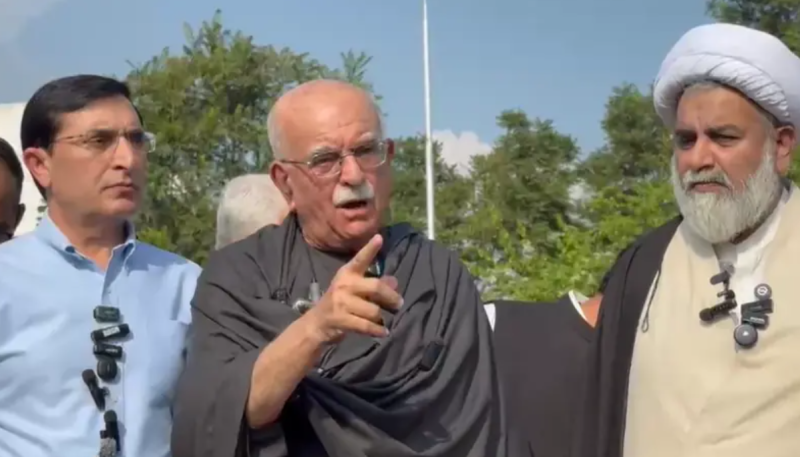
Speaking to reporters outside Parliament House on Monday, the National Assembly opposition leader compared the security situations in the two provinces and accused the government of applying different standards for political reasons.
“There is no writ of the state in half of Balochistan,” Achakzai claimed, alleging that the federal government had avoided imposing similar measures there because the provincial chief minister was politically favoured.
The federal government imposed emergency measures in 12 districts of KP on Sunday and placed the province under governor’s rule, citing what it described as the provincial government's disengagement from counterterrorism efforts.
Prime Minister Shehbaz Sharif, who chaired the federal cabinet meeting that approved the measures, highlighted the toll of terrorism on civilians, police personnel, security officials, women and children in KP and Balochistan.
According to figures compiled by the Pakistan Institute for Conflict and Security Studies (PICSS), Pakistan recorded 199 terrorist attacks in August. Khyber-Pakhtunkhwa, excluding the merged districts, accounted for 54 attacks, while Balochistan recorded 89.
Achakzai calls for democratic resistance
Achakzai described the imposition of emergency and governor’s rule in KP as an assault on the Constitution and democratic principles, urging political parties and other institutions to oppose the decision.
“This will not be tolerated,” he said, calling on those who value Pakistan and democracy to unite against the measures.
He said opposition parties would be asked to launch a democratic struggle against the decision from Tuesday in areas where they have political influence.
Achakzai stressed that the opposition intended to pursue peaceful resistance, saying it would not resort to violence or attacks against anyone.
He also reiterated demands for access to jailed former prime minister Imran Khan, including appropriate medical treatment. He said PTI leaders would keep details of any meeting confidential and inform the public only about Khan’s health if access were granted.
The political confrontation has intensified amid PTI’s planned march to Islamabad, which began on October 4 and was led by suspended KP Chief Minister Sohail Afridi. The party has demanded Khan’s release and criticised restrictions on access to him.
Despite the escalating tensions, Achakzai said the opposition remained open to negotiations with the federal government, while maintaining that it would continue its political struggle.
He also invited political parties to participate in an all-parties conference to discuss the country’s political direction and governance.
Raja Nasir Abbas criticises federal decision
Senate Opposition Leader Allama Raja Nasir Abbas, speaking alongside Achakzai, also condemned the federal government’s actions in KP.
Abbas questioned the government's commitment to constitutional principles, arguing that the provincial administration was being removed despite the PTI-led government having secured a two-thirds majority in the provincial assembly.
He alleged that the provincial government had sought to resolve security and political challenges through consultation with political and religious parties, while the federal government preferred unilateral decisions.
Abbas also echoed Achakzai’s argument that if deteriorating security justified emergency measures, the government should have considered imposing them in Balochistan first.
The federal government, meanwhile, has defended its decision on the grounds of security concerns and what it described as shortcomings in the provincial government's counterterrorism response.
PTI to challenge governor’s rule in court
PTI interim chairman Barrister Gohar Khan announced that the party would challenge the federal government’s decision to impose emergency and governor’s rule in the Peshawar High Court on Tuesday.
He said the party would also decide its parliamentary protest strategy at a meeting scheduled for the same day.
Gohar reiterated that PTI would not accept the measures and intended to continue its protests and political campaign.
He described October 11, when the emergency measures were imposed, as a dark day in Pakistan’s democratic history, arguing that the dismissal of the provincial government and the detention of its leadership undermined democratic representation.
The party has also criticised the federal government's handling of the crisis and questioned the legitimacy of the administrative changes.
The legal challenge is expected to become a key test of the constitutional basis for the federal government's intervention in KP.
With opposition parties preparing protests, PTI planning court action and negotiations yet to resolve the wider political dispute, the confrontation over emergency rule is likely to remain a central issue in Pakistan's political landscape.