
WEBDESK - NAYADAUR
Yemen’s Iran-aligned Houthis launched missiles and drones at four cities in southern Saudi Arabia on Tuesday, injuring 73 people and setting energy facilities ablaze in a major escalation of the widening Middle East conflict.
The Houthis said they had launched a broad military operation deep inside Saudi territory, targeting a Saudi airbase and facilities linked to state oil giant Aramco.
The attacks struck Khamis Mushait, Abha, Najran and Jazan, a major Red Sea port city that hosts a large refinery and power plant.
Saudi authorities said women and children were among those injured. Fires broke out at energy installations following the strikes, adding to concerns that renewed fighting could further disrupt oil supplies from the Gulf and Red Sea region.
Satellite images cited by Reuters showed thick black smoke over the Jazan refinery and white smoke rising from an oil distribution facility in Abha.
The attacks appeared to mark one of the most serious Houthi assaults on Saudi Arabia in recent years and threatened to reignite a conflict between Riyadh and the Yemeni movement that had largely subsided following a U.N.-brokered truce in 2022.
Saudi-led coalition spokesperson Turki al-Malki said the coalition would take “all necessary operational measures” to deter the Houthis and confront further attacks.
Houthi military spokesperson Yahya Saree accused Saudi Arabia of escalating hostilities through airstrikes in Yemen and warned that Riyadh’s actions would face a response.
Houthi-controlled media later reported Saudi airstrikes in Yemen’s Jubah district, east of Sanaa, and in southwestern Taiz province.
Oil Prices Rise on Supply Fears
The escalation comes as the wider Middle East conflict has already placed severe pressure on global energy markets.
Brent crude climbed as high as $99.46 a barrel on Tuesday, its highest level since July 24, while U.S. West Texas Intermediate crude reached its highest level since June 8 before both benchmarks pared some gains.
Renewed Houthi attacks could further complicate global energy flows by threatening Saudi infrastructure and shipping near the Bab el-Mandeb Strait, the strategic waterway connecting the Red Sea with the Gulf of Aden.
The latest fighting comes after a relatively calm August and amid renewed confrontation between the United States and Iran.
Iran has threatened additional restrictions around the Strait of Hormuz, through which about a fifth of global oil supplies traditionally pass, while Washington has sought to maintain shipping through the waterway and tighten economic pressure on Tehran.
Who Are the Houthis?
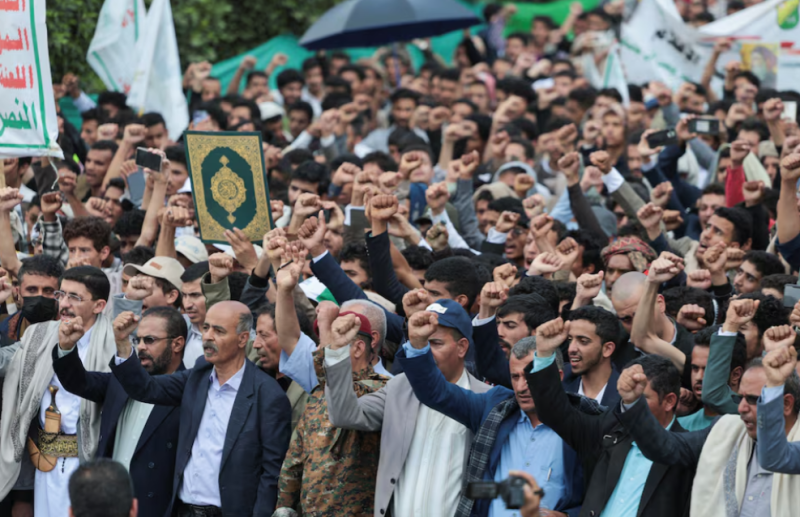
The Houthis, formally known as Ansar Allah, are a political and armed movement that controls most of northwestern Yemen, including the capital, Sanaa.
The movement emerged in northern Yemen during the 1990s from the Zaydi branch of Shiite Islam. It fought several conflicts with Yemen’s government before taking control of Sanaa in 2014 and forcing the internationally recognised government south.
Saudi Arabia led a military coalition into Yemen in 2015, seeking to restore the government and counter what Riyadh regarded as expanding Iranian influence on its southern border.
Years of warfare followed, creating one of the world’s most severe humanitarian crises while failing to decisively dislodge the Houthis from northern Yemen.
A U.N.-brokered truce in 2022 significantly reduced fighting, but tensions have surged again this year.
The Houthis have demonstrated increasingly sophisticated missile and drone capabilities, previously striking Saudi and Emirati oil installations and other infrastructure.
They also disrupted international shipping in the Red Sea between 2023 and 2025, forcing many vessels travelling between Asia and Europe to divert around Africa.
Iran-Houthi Relationship
Iran considers the Houthis part of its regional “Axis of Resistance,” which has also included Lebanon’s Hezbollah and Iran-aligned Iraqi armed groups.
The United States accuses Tehran of supplying the Houthis with weapons, training and financial assistance. The Houthis reject the description of themselves as an Iranian proxy and say their military capabilities are independently developed.
Although closely aligned with Tehran on several regional issues, the movement also has deep domestic political and religious roots in Yemen.
The latest escalation comes as Saudi-backed Yemeni government forces have launched operations on several fronts against Houthi-controlled territory.
More than 18,500 people have fled their homes because of fighting along Yemen’s west coast over the past three days, according to the International Organization for Migration.
Renewed warfare between Saudi Arabia and the Houthis now risks reopening another major front in an already expanding Middle East conflict while increasing pressure on Red Sea shipping and global energy markets.