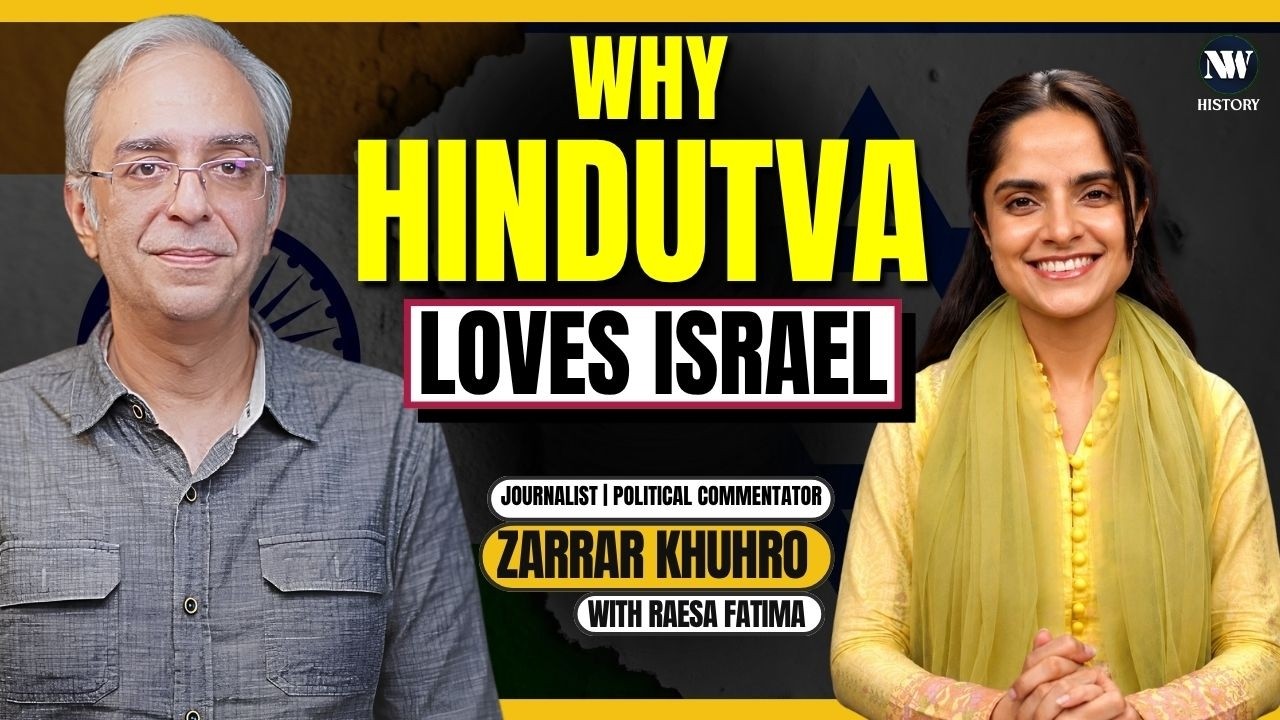
Veteran journalist and columnist Zarrar Khuhro offered a sweeping critique of contemporary geopolitics, arguing that ideology alone explains little unless understood through the lens of power, history and national interest.
Discussing the relationship between Hindutva and Zionism, Khuhro argued that the alliance extends far beyond recent diplomatic ties between India and Israel. According to him, both movements share a common framework built upon majoritarian nationalism and the politics of "othering". He suggested that strategies employed by Israel in the occupied Palestinian territories, from collective punishment to surveillance and demographic control, have increasingly found parallels in India's governance under the BJP, particularly in Kashmir.
On the question of why criticism of Zionism attracts accusations of anti-Semitism while criticism of Hindutva does not generate similar consequences, Khuhro maintained that the answer lies in political influence rather than principle. He argued that decades of lobbying and institutional power have enabled Israel to equate criticism of Zionism with hostility towards Judaism, making dissent professionally and politically costly in many Western countries.
Reflecting on the war in Gaza, Khuhro delivered perhaps his strongest assessment of Western liberalism. He argued that ideals such as universal human rights, freedom of expression and the rules-based international order have been applied selectively, adding that "the façade of Western liberalism lies buried beneath the rubble of Gaza." For him, national interest, not moral values, continues to drive global politics.
Turning to Pakistan's identity, Khuhro rejected the notion that the country must choose between its Islamic heritage and the legacy of the Indus Valley Civilisation. He argued that Pakistan's history encompasses both, describing Mohenjo-daro, Taxila, Raja Dahir, Muhammad bin Qasim and subsequent Islamic civilisations as equally integral to the country's historical inheritance.
The discussion also explored Pakistan's political discourse, where Khuhro questioned the usefulness of imported ideological labels such as "liberalism". Rather than subscribing to rigid ideological camps, he advocated a pragmatic approach centred on what works in practice. In his view, effective governance depends upon national cohesion, economic strength and credible state power rather than abstract political ideals.
On global affairs, Khuhro described the United States as an empire in relative decline, arguing that although it remains the world's most powerful military force, its ability to shape international outcomes has diminished. He maintained that every empire follows a historical life cycle and that the emerging global order will increasingly reflect a more multipolar balance of power rather than continued American dominance.
Ultimately, the conversation returned to a recurring theme: in international politics, moral arguments alone rarely determine outcomes. History, Khuhro suggested, continues to be written by those capable of exercising power.