
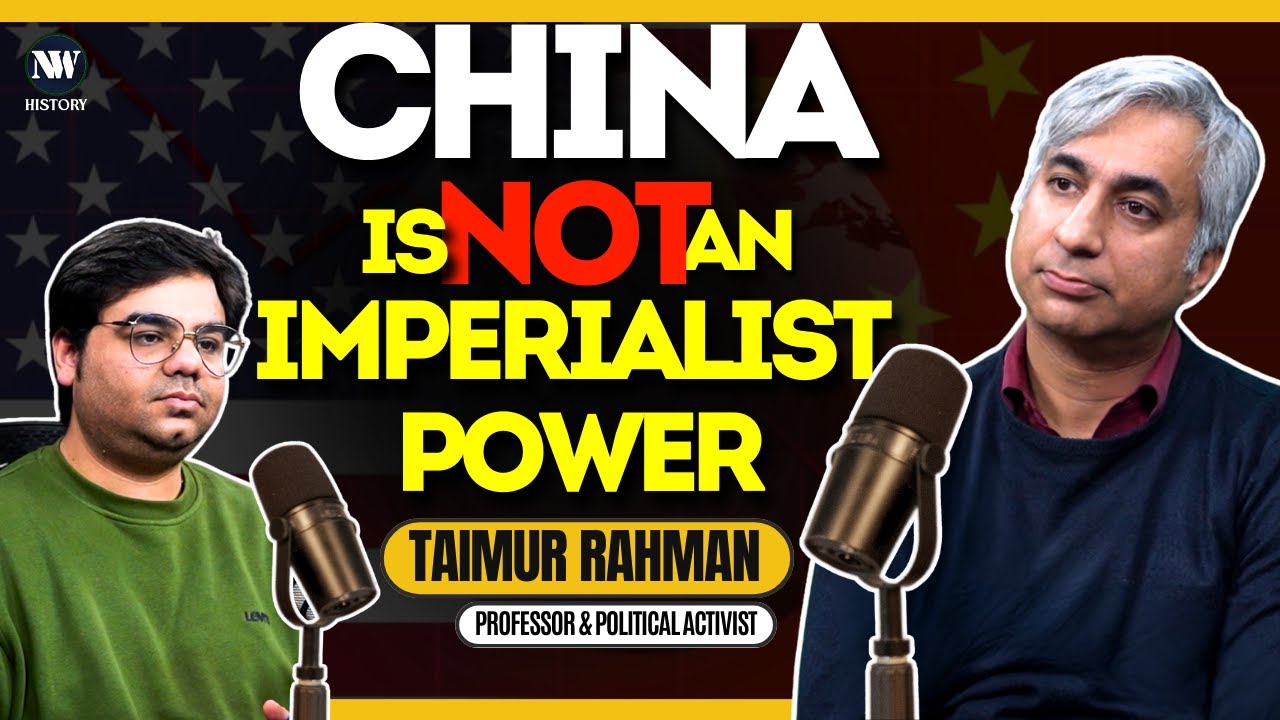
A wide-ranging discussion on global power, imperialism and Pakistan’s political economy discussed on the latest episode of New Wave History, where political scientist and activist Dr Taimur Rahman made a robust critique of Western narratives portraying China as an emerging imperial power.
Dr. Taimur Rahman questioned the assumption that China is replacing the United States as the primary exploiter of the Global South. He urged audiences to examine material evidence rather than media-driven fears, contrasting China’s global footprint with that of the United States. While the US operates an estimated 900 military bases worldwide, China maintains only one overseas base, located in Djibouti, a fact, Rahman argued, that fundamentally undermines claims of Chinese imperial expansion.
The discussion also addressed the widely circulated “debt-trap diplomacy” narrative, particularly in relation to Sri Lanka. Rahman cited debt data showing that nearly 90 per cent of Sri Lanka’s external debt is owed to Western and multilateral lenders rather than China. He stressed that Chinese financing is largely project-based, unlike IMF loans that often impose sweeping structural reforms, including privatisation and austerity measures.
Rahman placed these arguments within a broader historical critique of liberalism, tracing its roots to European colonialism and elite dominance. He argued that liberal democracy, while rhetorically committed to freedom and rights, has frequently enabled the concentration of political power in the hands of wealth, producing what he described as “elite capture” across both Western and postcolonial states.
Turning to China’s development trajectory, Rahman highlighted land reforms, mass education, universal healthcare initiatives and state-led poverty alleviation as key factors behind its economic transformation. He contrasted this with Pakistan’s persistent feudal structures, weak public services and dependence on external financial institutions.
Addressing concerns from ethnonationalist movements within Pakistan, particularly in Balochistan, Rahman acknowledged historical grievances against the state but argued that foreign investment, regardless of its source, inevitably passes through domestic power structures. The real challenge, he maintained, lies in Pakistan’s internal class structure and political economy, not in China’s intentions.
Concluding the discussion, Rahman emphasised that Pakistan cannot reshape global powers but can reform itself to negotiate more effectively. “You cannot fix America or China,” he said. “But you can fix Pakistan, and then deal with the world on your own terms.”