
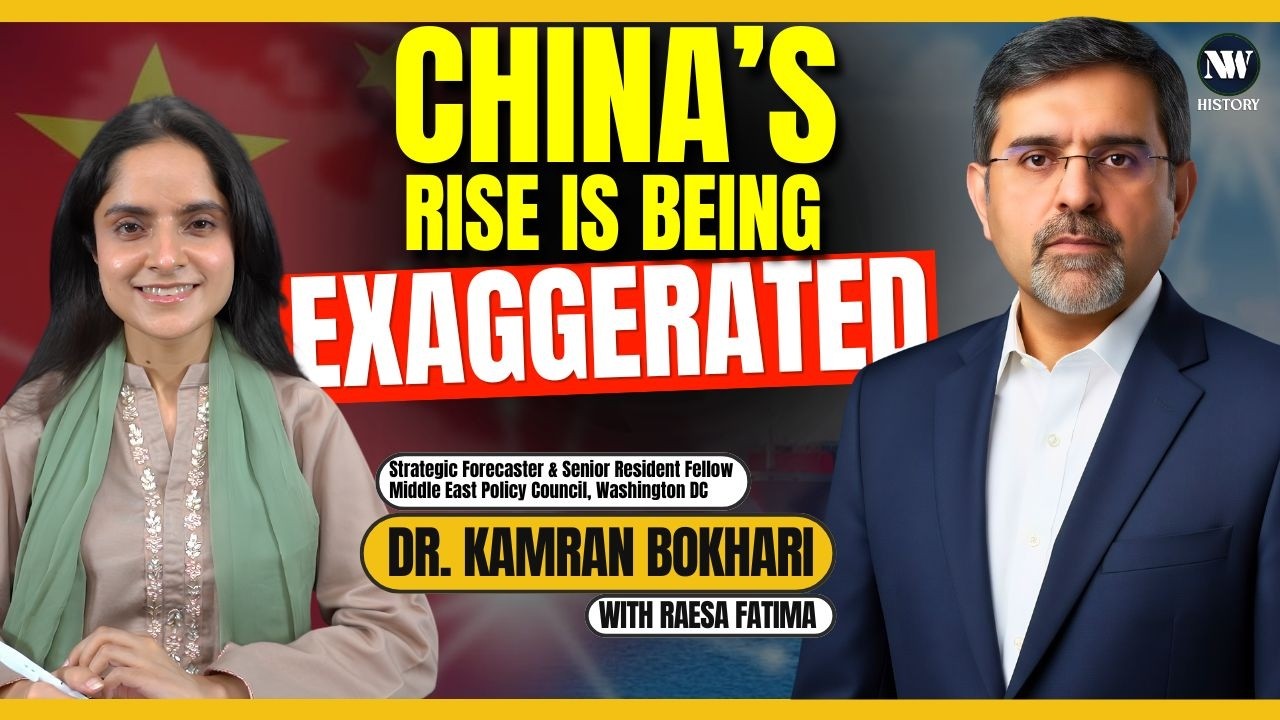
For years, analysts have debated whether the 21st century will witness the decline of American dominance and the rise of Chinese influence across the Muslim world. In a wide-ranging conversation with New Wave History, geopolitical analyst Dr. Kamran Bokhari challenged many of the assumptions driving that debate.
Bokhari began by questioning the very idea of a singular “Muslim world.” From Pakistan to Central Asia, the Gulf, and North Africa, Muslim-majority countries are divided by geography, ethnicity, language and national interests. Rather than acting as a unified bloc, they are fragmented political arenas with distinct priorities and rivalries.
According to Bokhari, the notion that the United States is in irreversible decline is overstated. Washington, he argued, is not retreating from global affairs but changing the way it manages international order. Instead of bearing the entire burden of security, the United States is shifting towards a model of burden-sharing, encouraging allies such as Saudi Arabia, Turkey and Pakistan to play larger regional roles.
China, by contrast, has achieved considerable economic influence but remains strategically constrained. Bokhari described Beijing’s political-economic system as fragile, dependent on single-party rule and slowing growth. More importantly, China lacks the military power projection capabilities necessary to shape events in conflict-prone regions such as the Middle East.
Projects such as the Belt and Road Initiative and the China-Pakistan Economic Corridor have expanded Beijing’s presence, but Bokhari cautioned that infrastructure investment does not automatically produce strategic control. Countries including Pakistan, Sri Lanka and Zambia have accumulated significant debt without experiencing the economic take-off originally promised. In Pakistan’s case, he noted, repeated requests for Chinese loan rollovers illustrate the limits of debt-driven development.
The discussion also turned to the India-Middle East-Europe Economic Corridor. Bokhari argued that while the project remains conceptual, recent tensions involving Iran have increased its strategic relevance as Gulf states seek alternatives to the Strait of Hormuz for exporting energy and conducting trade.
Despite concerns over American reliability, Bokhari maintained that Gulf monarchies still have no viable alternative to the United States for hard security. China may be a major trading partner, but diplomacy and commerce alone cannot replace military guarantees.
Looking ahead, Bokhari rejected simplistic notions of a Chinese-led order or a cohesive Muslim geopolitical bloc. Instead, he predicted the rise of competing middle powers, including Turkey, Saudi Arabia, Pakistan and a potentially transformed Iran, whose interactions will shape the future of Eurasia and the broader Muslim world.