
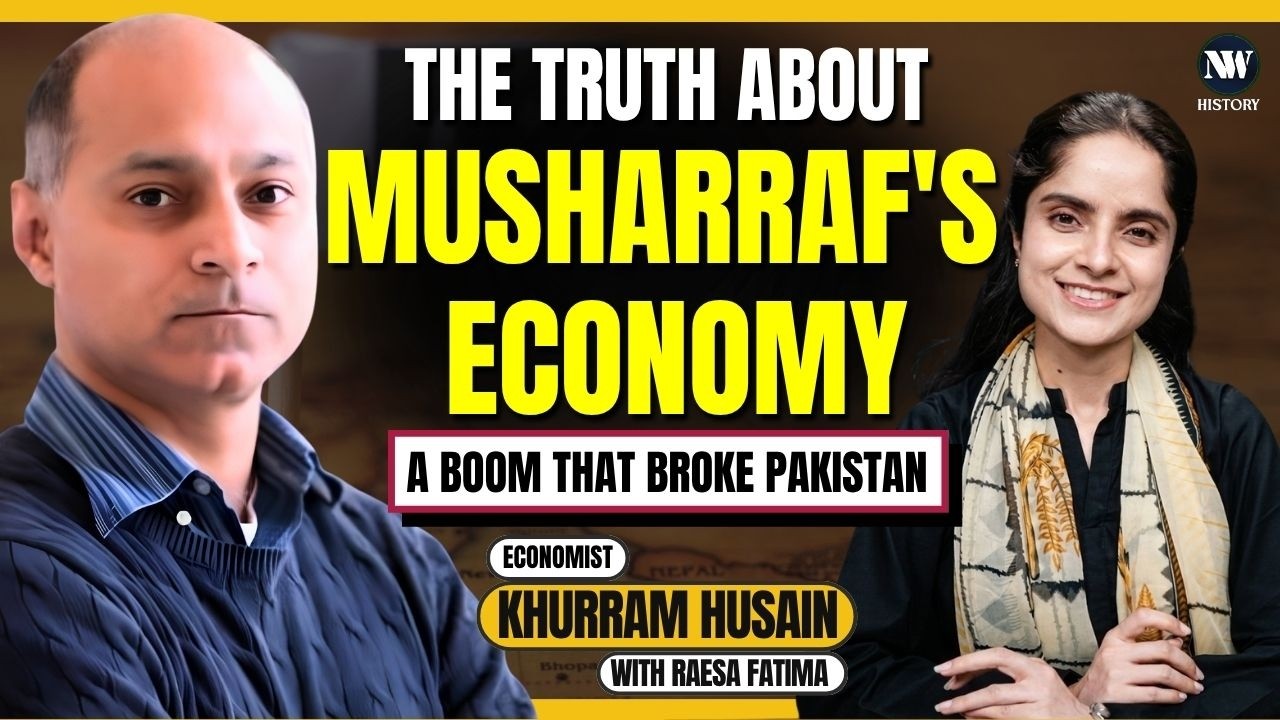
Pakistan's repeated return to the International Monetary Fund (IMF) reflects far deeper structural problems than budget deficits or external debt alone, according to veteran economic journalist Khurram Husain. Speaking in a podcast interview, Husain argued that the country's economic trajectory has been shaped by decades of policy choices that prioritised national security over long-term economic development, creating a cycle of instability from which Pakistan has yet to escape.
Asked why Pakistan has entered more than two dozen IMF programmes without resolving its underlying economic weaknesses, Husain rejected the idea of a single cause but identified the state's historic strategic priorities as a defining factor. He argued that successive governments placed economic competitiveness, education, healthcare and industrial productivity behind security concerns, leaving Pakistan without a sustainable development model.
Turning to the Musharraf era, Husain acknowledged that while economic growth exceeded six per cent during much of the 2000s, the expansion rested largely on foreign inflows, consumer credit and imports rather than productivity. He contended that policy changes after 9/11 transformed Pakistan into a consumption-driven economy that became structurally dependent on external financing, laying the foundations for the balance-of-payments crisis that emerged in 2008.
Husain also challenged the widespread use of GDP growth as the primary measure of economic success. He noted that inflation, foreign exchange pressures and external imbalances had been worsening even while headline growth remained strong, suggesting that the apparent prosperity of the period concealed deep structural vulnerabilities. According to him, the 2008 crisis merely exposed problems that had accumulated over several years.
Discussing Pakistan's persistent fiscal deficit, Husain said the problem extends beyond poor governance and inadequate taxation. He criticised the country's political and business elites for failing to develop a coherent long-term economic vision capable of adapting to an increasingly globalised world. Rather than pursuing productivity and competitiveness, successive governments relied on short-term consumption-led growth while postponing essential reforms.
On the energy sector, Husain argued that Independent Power Producers (IPPs) were never intended to be a permanent solution. He explained that the original framework was designed as one component of broader reforms, including restructuring the power sector, introducing market-based pricing and unbundling WAPDA. Those reforms stalled, leaving Pakistan with what he described as the "worst of both worlds", private-sector costs combined with public-sector inefficiencies, contributing to the country's chronic circular debt.
Regarding the China-Pakistan Economic Corridor (CPEC), Husain predicted that history would judge different components differently. While acknowledging that power projects expanded electricity generation capacity, he suggested Pakistan may have commissioned more capacity than the economy could sustain. He added that projects such as Gwadar Port and transport infrastructure may ultimately acquire greater strategic significance, though their long-term legacy remains uncertain.
Looking ahead, Husain argued that Pakistan must focus on improving productivity, broadening its tax base, rebuilding trust between citizens and revenue authorities, investing heavily in education and healthcare, and encouraging higher-value manufacturing. He concluded that the country's economic challenges ultimately reflect what he described as a collective "failure of political imagination", arguing that Pakistan's political, business and state elites have consistently failed to develop a shared long-term national strategy capable of breaking the recurring cycle of crisis and IMF dependence.