
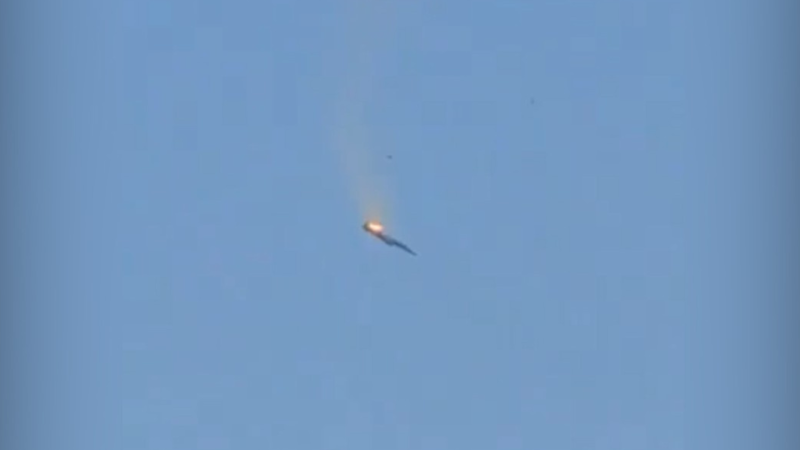
Amid a rapidly escalating conflict in the Middle East, Kuwait’s air defences mistakenly shot down three US F-15 fighter jets on Monday, US Central Command said, describing it as an apparent friendly-fire incident during active combat with Iran. All six crew members ejected safely and were recovered in stable condition, Centcom confirmed.
“During active combat — including attacks from Iranian aircraft, ballistic missiles, and drones — the US Air Force fighter jets were mistakenly shot down by Kuwaiti air defences,” Centcom said. Kuwait has acknowledged the incident, and an investigation is underway. Video footage verified by Reuters shows a US warplane spiralling to the ground over the Al Jahra area of Kuwait, with a parachuting crew member visible.
A US F-15 fighter jet crashed in Kuwait, footage posted to social media shows.
— The Friday Times (@TFT_) March 2, 2026
According to reports, at least one pilot managed to eject.
There is no immediate comment from the American military on the circumstances of the incident. pic.twitter.com/ts12Ny7dlI
The friendly-fire incident comes as Iranian retaliatory strikes continue following the killing of Supreme Leader Ayatollah Ali Khamenei in a joint US-Israeli attack. Iran has targeted both military and civilian areas across the Gulf, prompting repeated air raid sirens in Kuwait, Abu Dhabi, Doha, and Manama.
Smoke was also reported near the US Embassy in Kuwait City, though no injuries have been confirmed. Authorities urged residents and foreign nationals to shelter in place, remain on lower floors, and avoid windows.
The conflict’s toll in Iran has been severe. The Red Crescent reported at least 555 fatalities across 131 counties, with strikes hitting Tehran, Sanandaj, Bushehr, and Minab. In Minab, an elementary school for girls was struck, leaving more than 160 dead, while at least 20 civilians were killed in Tehran’s Niloofar Square. Humanitarian access remains critical, exacerbated by an internet blackout that has now lasted over 48 hours.
In neighbouring countries, the impact has been felt across infrastructure and civilians alike. Saudi Arabia temporarily shut down its Ras Tanura refinery after debris from intercepted drones sparked a fire, though no casualties occurred. Two workers sustained minor injuries from falling debris at Kuwait’s Mina al-Ahmadi refinery.
In Lebanon, Israeli strikes on Hezbollah positions have killed at least 31 people and injured 149, while displacing civilians in southern Lebanon and Beirut’s suburbs. In Iraq, US-Israeli strikes on Kataib Hezbollah sites south of Baghdad caused substantial material damage.
Economic and technological disruptions are mounting. Amazon Web Services reported power and connectivity outages at its data centres in Bahrain and the United Arab Emirates, forcing an automatic shutdown in one zone after sparks ignited a minor fire. Global air travel has been heavily affected, with over 3,400 flights cancelled across the Gulf, including at major airports in Doha, Dubai, Abu Dhabi, and Sharjah. Governments such as the United Kingdom are arranging evacuations for their citizens.
Iran’s National Security Council secretary Ali Larijani rejected any notion of new negotiations with Washington, insisting that Iran is defending itself and will not seek talks while under attack. Analysts warn Gulf states face a precarious choice: to engage militarily alongside Israel or remain passive as their cities are targeted, with long-term implications for regional stability.