
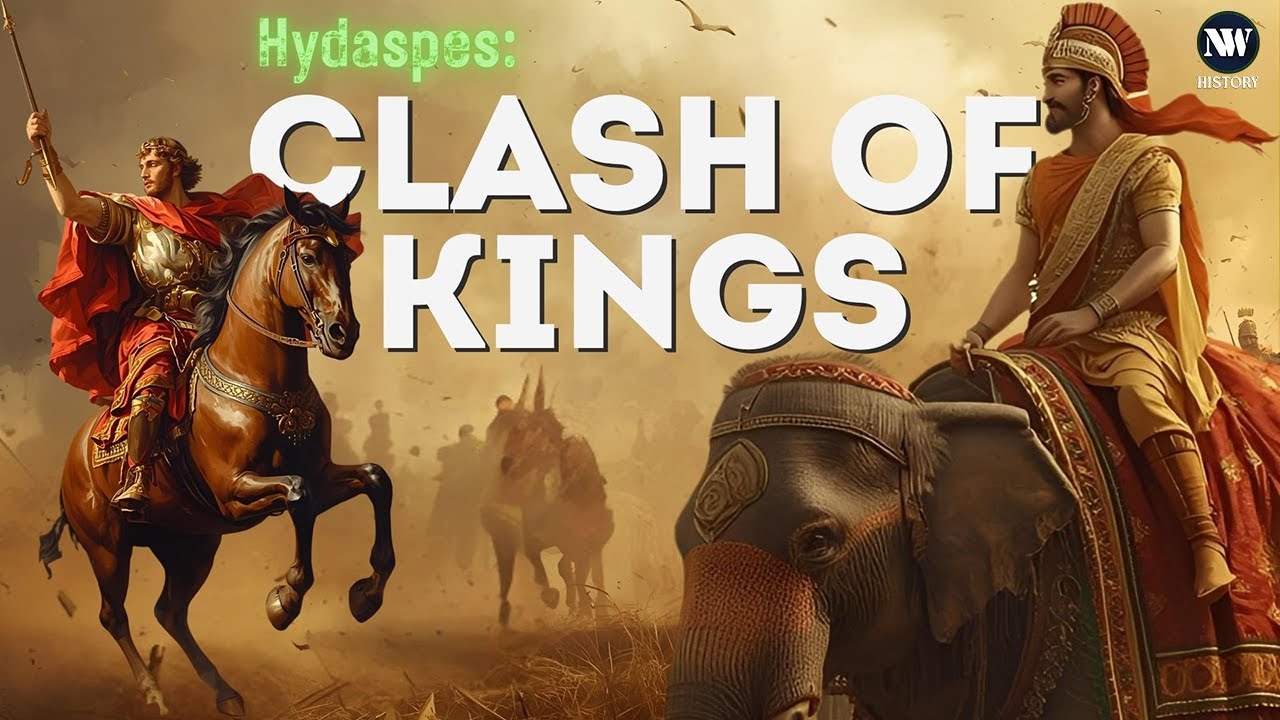
In 326 BCE, on the banks of the River Hydaspes, modern-day Jhelum in Pakistan, Alexander the Great confronted one of his most formidable opponents: King Porus of the Paurava kingdom. This legendary clash became not only a test of arms but also a defining cultural encounter between the Macedonian conqueror and the Indian subcontinent. It was a moment where two vastly different worlds, traditions, and armies collided in a battle that would echo through the ages.
Fresh from his victories over Persia, Alexander pressed eastward, determined to expand his empire. Standing in his path was Porus, a towering ruler who commanded fierce loyalty and an army unlike any Alexander had faced. With nearly 30,000 infantry, 4,000 cavalry, and 200 war elephants, Porus turned the Hydaspes into a wall of living steel. The sheer presence of elephants on the battlefield gave his army an aura of invincibility.
Crossing the river directly would have been suicidal. Instead, Alexander resorted to deception, feigning movements along the western bank while secretly scouting for an upstream crossing. On a stormy night, his forces slipped across the river, catching Porus off guard. This maneuver showcased not only Alexander’s boldness but also his mastery of psychological warfare.
The ensuing battle was brutal. Elephants thundered into the Macedonian phalanx, trampling soldiers and scattering formations. But disciplined infantry struck back, targeting the animals’ drivers and forcing the beasts into chaos, often trampling Porus’s own men. Meanwhile, Alexander’s cavalry encircled the enemy flanks, slowly tipping the scales.
Through it all, Porus displayed extraordinary valor, commanding from atop his elephant even as his army faltered. Captured but unbroken, he told Alexander he wished to be treated “like a king.” Struck by his courage, Alexander spared him, restored his throne, and even expanded his territory. This unusual act of magnanimity turned a defeated enemy into a loyal ally.
The Battle of the Hydaspes became one of Alexander’s hardest-won victories and marked the easternmost limit of his conquests. It symbolized not just the brilliance of his strategy but also the resilience of local powers. On the banks of the Jhelum, East and West collided, leaving behind a legacy of valor, ambition, and respect that continues to inspire historians and storytellers alike.