
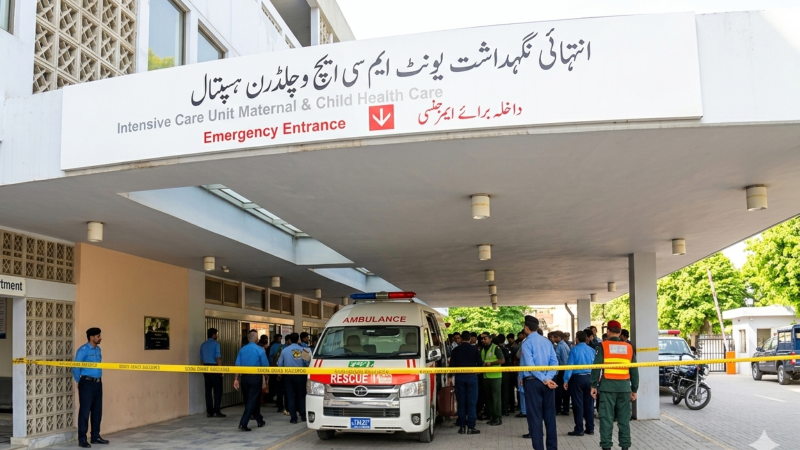
There are tragedies that happen without warning, and then there are tragedies that expose how badly a system has failed. The fire at the Pakistan Institute of Medical Sciences (PIMS) in Islamabad, which claimed the lives of newborn babies, belongs to the second category, as the preliminary findings point towards failures in safety, preparedness and institutional responsibility.
The disturbing aspect of the PIMS incident is that the tragedy appears to have involved a chain of preventable failures rather than one isolated mistake. Fires do not become deadly merely because a flame appears. They become deadly when alarms do not work, evacuation procedures are inadequate, emergency equipment is unavailable or staff are not sufficiently prepared to respond. This is precisely why institutional inquiries must go beyond identifying the individual who happened to be closest to the failure. Pakistan has a familiar habit of looking for a person to blame after a disaster. Hospital administrations, safety regulators, engineering departments and relevant government authorities must also answer whether safety inspections were conducted properly, whether deficiencies had previously been identified, whether corrective measures were implemented and whether emergency protocols were actually tested rather than merely documented.
There is another uncomfortable dimension to the incident: the victims were newborn children. They had no voice, no ability to escape and no capacity to protect themselves. Their survival depended entirely on the adults and systems surrounding them. Their deaths therefore represent not only a medical tragedy but also a profound institutional failure of care.
Public hospitals already operate under enormous pressure. Overcrowding, inadequate resources, staff shortages and administrative dysfunction are realities that should not be neglected. But resource constraints cannot become a permanent excuse for failing to maintain basic safety standards. Fire extinguishers, functioning alarms, emergency exits, evacuation plans and trained personnel are fundamental requirements of a functioning hospital. Hospitals should conduct regular drills, and those drills should be evaluated honestly. The newborns who died at PIMS cannot be brought back. But their deaths should not become another statistic in the country's long record of preventable tragedies.