
WEBDESK - NAYADAUR
Lambeth Palace has withdrawn an interfaith award presented to Pakistani religious leader Hafiz Muhammad Tahir Mehmood Ashrafi after comments he made about Osama bin Laden in 2007 resurfaced.
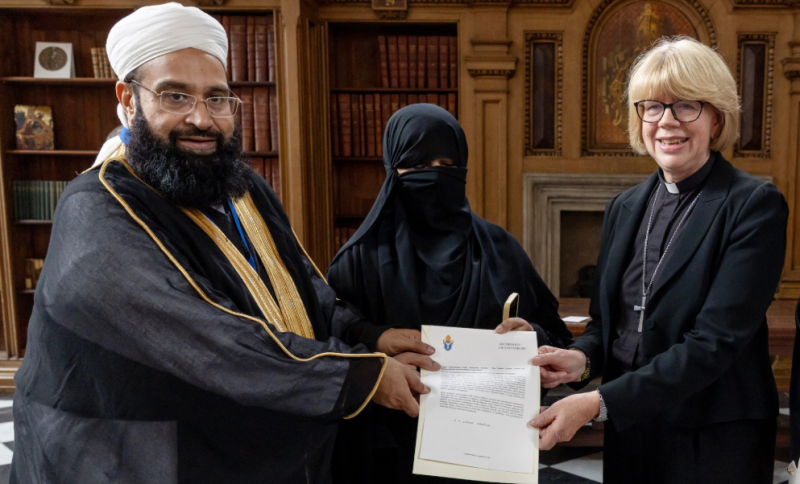
Ashrafi received the Hubert Walter Award for Reconciliation and Interfaith Cooperation at Lambeth Palace last week. The honor recognized what the Archbishop of Canterbury’s office described as his longstanding work supporting religious minorities in Pakistan, particularly the Christian community.
The award was presented on Sept. 11, the 25th anniversary of the 2001 attacks in the United States, adding further sensitivity to the decision.
What prompted the withdrawal?
Lambeth Palace said previously made comments by Ashrafi had recently come to light and prompted officials to reconsider the award.
“Previous comments made by Imam Ashrafi have come to light that have led Lambeth Palace to reconsider this award,” the palace said, confirming that the honor had been withdrawn.
The palace also said Ashrafi had been contacted about the decision.
The remarks date back to 2007 and were made in the context of Britain's decision to award author Salman Rushdie a knighthood.
According to contemporary reporting, Ashrafi said he would give bin Laden the title “Saifullah,” meaning “Sword of Allah,” describing it as a title associated with a Muslim warrior.
Bin Laden founded Al-Qaeda and was identified by the United States as the mastermind of the Sept. 11 attacks, which killed nearly 3,000 people. He was killed by U.S. forces in Pakistan in 2011.
How has Ashrafi responded?
Ashrafi has rejected the interpretation that his remarks represented an endorsement of bin Laden.
According to statements attributed to him, he made the comments while responding to the British government's decision to honor Rushdie, whose novel The Satanic Verses had generated widespread controversy among Muslims.
Ashrafi's position is that he was using bin Laden as a comparison to illustrate the anger felt by many Muslims over Rushdie receiving a British honor.
His spokesperson has argued that the remarks have been presented without their wider context and that Ashrafi's record opposing terrorism and violent extremism should also be considered.
Ashrafi has also said that the title mentioned in his remarks was never actually bestowed on bin Laden.
Why had Ashrafi received the award?
Lambeth Palace said the award recognized Ashrafi's work in religious reconciliation, interfaith cooperation and support for religious minorities, particularly Pakistan's Christian community.
His involvement in the 2012 Rimsha Masih case was also highlighted. Rimsha Masih, a young Christian girl, had been accused of blasphemy in Pakistan. Her case attracted international attention and became an important reference point in discussions about blasphemy laws and the treatment of religious minorities.
Ashrafi has defended Pakistan's blasphemy laws while also arguing that they should not be misused.
Human Rights Watch has taken a different position, arguing that Pakistan's blasphemy laws can facilitate discrimination and be abused against vulnerable and minority communities.
Reaction in Britain
The decision to withdraw the award has been welcomed by critics of the original honor, while others have questioned why Ashrafi received it in the first place.
The National Secular Society welcomed the withdrawal but questioned the decision to present an interfaith award on the anniversary of the Sept. 11 attacks.
The controversy has consequently raised questions not only about Ashrafi's 2007 remarks but also about the process used to assess recipients and review their public records before awards are granted.
What happens next?
Lambeth Palace has reaffirmed its commitment to dialogue and cooperation across religious and ideological differences.
The withdrawal therefore appears to concern the specific award presented to Ashrafi rather than a broader retreat from interfaith engagement.
For Ashrafi, the central dispute remains whether his 2007 comments should be understood as an endorsement of bin Laden or as remarks made in the specific context of the controversy surrounding Rushdie's British honor.
Why it matters
The episode highlights the continuing difficulty of assessing public figures whose past statements can resurface years later, particularly when those statements involve terrorism, religion, and interfaith relations. It also places renewed attention on how institutions conduct due diligence before honoring prominent religious figures.