
WEBDESK - NAYADAUR
BRICS leaders have condemned last year's deadly Pahalgam attack in Indian-administered Kashmir while also expressing strong support for Palestine and calling for a ceasefire in Gaza, in a joint declaration that India has portrayed as a diplomatic success.
The 45-page document, known as the New Delhi Declaration, was approved during the BRICS summit in India's capital and signed by leaders of Brazil, Russia, India, China, South Africa, Egypt, Iran, the United Arab Emirates, Indonesia and Ethiopia.
The declaration condemned the April 22, 2025, attack in Jammu and Kashmir, in which 26 people were killed and several others wounded. India blamed Pakistan for the attack, an allegation Islamabad rejected while calling for an impartial investigation.
The BRICS statement did not name Pakistan. Instead, it condemned terrorism in broad terms and called for collective action against terrorism, its financing, cross-border terrorism and safe havens.
“We strongly condemn the terrorist attack” in Jammu and Kashmir, the declaration said, according to the source material, while emphasizing that terrorism should not be associated with any religion, nationality, civilization or ethnic group.
The declaration also rejected any justification for terrorism regardless of its cause or motive and called for zero tolerance and an end to double standards in counterterrorism efforts.
The Pahalgam attack became a major flashpoint between India and Pakistan. The two nuclear-armed neighbors fought a four-day military confrontation in May 2025, with both sides claiming to have inflicted significant losses on the other.
Some Indian analysts and commentators have described the inclusion of Pahalgam in the BRICS declaration as a significant diplomatic achievement for Prime Minister Narendra Modi.
Indian journalist Rahul Shiv Shankar called it a major diplomatic success, pointing particularly to China's endorsement of the declaration.
Pakistani journalist Kamran Yousuf, however, argued that the wording did not amount to an endorsement of India's position on Kashmir. He noted that Pakistan itself had condemned the Pahalgam attack and that the declaration referred to the location as Jammu and Kashmir rather than explicitly describing it as Indian territory.
Former Jammu and Kashmir chief minister Mehbooba Mufti welcomed the condemnation but said terrorism could not be condemned selectively and that civilian lives should not be judged by nationality.
At the same time, the BRICS declaration devoted significant attention to the Israel-Palestinian conflict. The group called for a ceasefire in Gaza and unrestricted humanitarian access, while opposing the forced displacement of Palestinians and demographic or territorial changes in Gaza.
BRICS leaders backed a two-state solution, envisioning an independent and sovereign Palestinian state based on internationally recognized borders from before 1967, with East Jerusalem as its capital.
The declaration also condemned attacks on civilians, medical facilities and other civilian infrastructure and criticized restrictions on humanitarian assistance.
The emphasis on Palestine is notable given India's close relationship with Israel. Analysts said India's support for the language also reflected the importance of the Palestinian issue among BRICS' newer members and across the wider Global South.
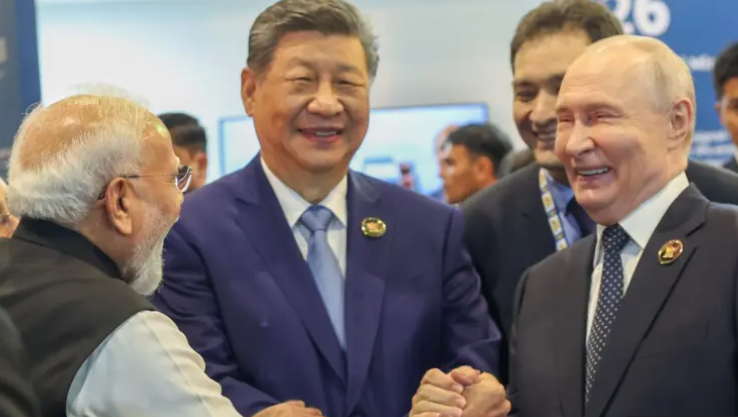
The summit brought together major emerging economies and leaders, including Chinese President Xi Jinping, Russian President Vladimir Putin, and Iranian President Masoud Pezeshkian.
The meeting also drew attention to contacts between Iran and the United Arab Emirates, highlighting the increasingly complex diplomatic alignments within the expanded BRICS grouping.