
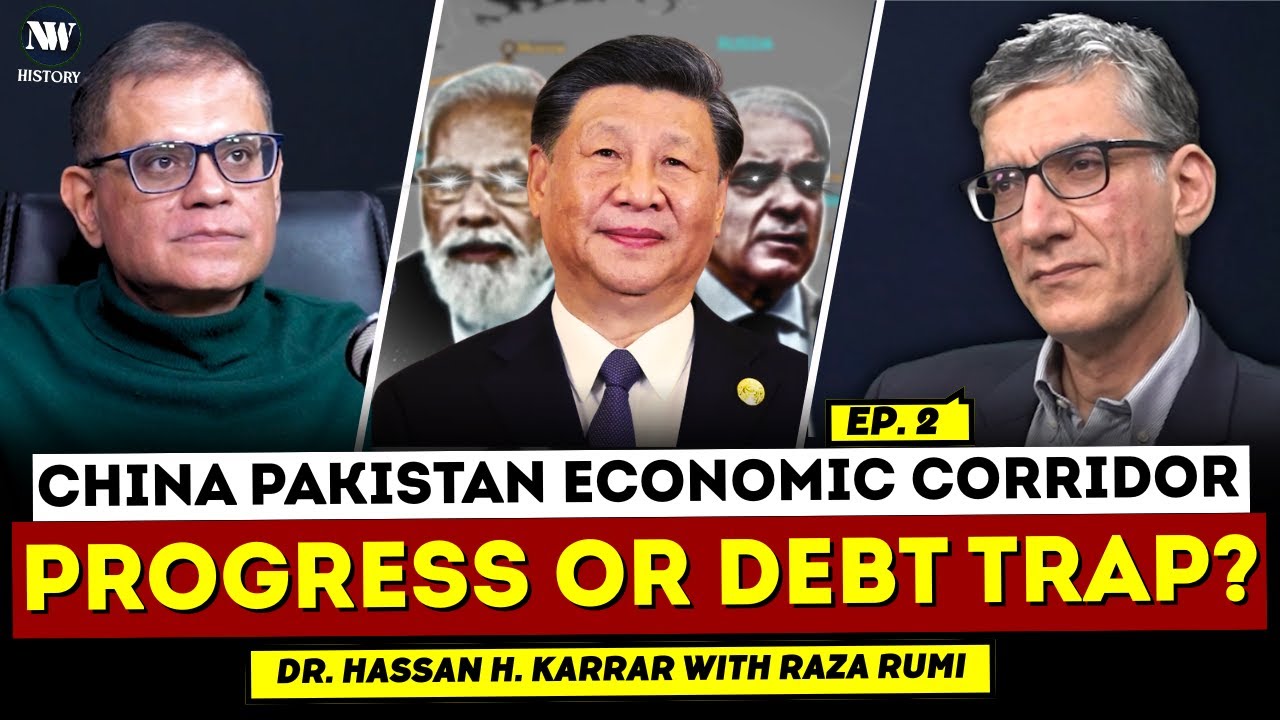
Nearly a decade after it was unveiled as a transformational project for Pakistan’s economy, the China–Pakistan Economic Corridor (CPEC) appears to have reached a plateau, according to a leading academic specialising in China and Central Asia.
Speaking on the New Wave History podcast, Professor Hassan H. Karrar of the Lahore University of Management Sciences (LUMS) said there has been little evidence of major new investment under the formal CPEC framework in recent years. While Chinese firms remain involved in infrastructure projects across Pakistan, he stressed that many high-profile schemes, including large dams, fall outside the CPEC mechanism and rely on complex financing involving the state and international donors.
Professor Karrar suggested that a broader reassessment by Chinese financiers began around the time of the Covid-19 pandemic, as concerns grew about whether recipient countries had the capacity to repay large infrastructure loans. He pointed to stalled projects in Kenya, debt distress in Sri Lanka, and reassessments in Malaysia as signs of a wider pattern rather than a Pakistan-specific issue.
“In Beijing, there is a clear emphasis that these are loans, not aid,” he said, adding that Chinese officials increasingly expect partner countries to address their own structural weaknesses.
One of the most significant missed opportunities, according to Professor Karrar, was the failure to operationalise special economic zones under CPEC. These zones were intended to generate employment, foster technological transfer and build long-term industrial capacity. “They never really got off the ground,” he said, describing this as a major setback in realising CPEC’s original vision.
The discussion also focused on Gwadar port in Baluchistan, once promoted as a future regional hub. Despite billions spent on its development, the port remains largely underutilised. Professor Khan described Gwadar as a heavily securitised city with limited economic activity, arguing that infrastructure alone cannot succeed without addressing deep-rooted political and historical grievances dating back to 1948.
Security concerns, particularly attacks on Chinese interests, and Pakistan’s ongoing fiscal crisis, which culminated in repeated IMF bailouts, were also cited as key factors slowing momentum. At the same time, Karrar noted that China remains invested in its relationship with Pakistan, though future cooperation may favour smaller, more manageable projects over large, headline-grabbing ventures.
As CPEC enters its second decade, the conversation underscored a sobering conclusion: without political inclusion, local buy-in and genuine capacity building, even the most ambitious infrastructure corridors risk falling short of their promise.