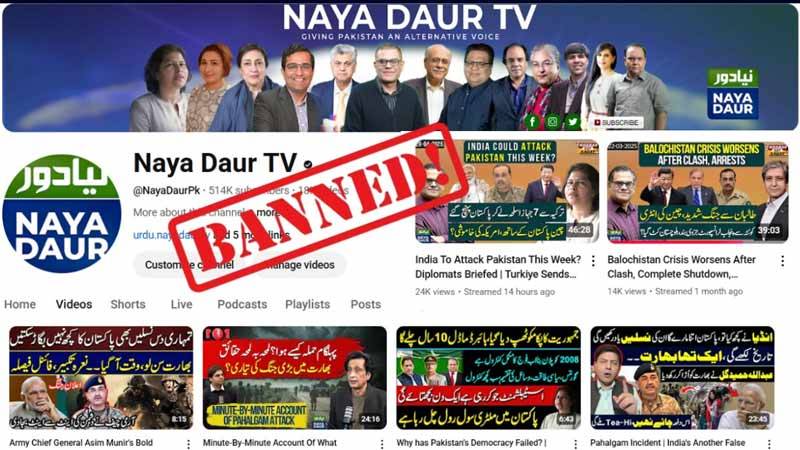
On Tuesday, April 29, 2025, we received an email from YouTube informing us that our channel, Naya Daur TV, has been blocked from viewership in India following an "order from the Government [of India] related to national security or public order."
This did not come as a surprise. Just a day earlier, a list had surfaced online showing several Pakistani YouTube channels that had been blocked in India. While many of these were affiliated with satellite news networks, the list also included the platforms of prominent independent journalists such as Umar Cheema, Asma Shirazi, Irshad Bhatti, and The Pakistan Experience, founded and run by Shehzad Ghias.
This development followed a terrorist attack on April 22 in the Pahalgam area of Indian-administered Jammu and Kashmir, which claimed 26 lives. A little-known group called The Resistance Front initially claimed responsibility. Indian authorities believe the group to be an offshoot of the internationally proscribed terrorist organization Lashkar-e-Taiba.
In the six days that followed—while Naya Daur TV remained accessible in India—we produced dozens of videos analyzing the tragedy, seeking to understand the unfolding facts. Amid the rising war hysteria fueled by politicians and media on both sides of the border, we made a conscious effort to present calm, reasoned perspectives. Our platform aimed to amplify voices calling for peace, caution, and critical thinking, rather than simply echoing any state's narrative.
We also welcomed Indian viewers to participate in the conversation via comments on our videos. While some comments were hostile or even openly racist, we chose to leave them visible. Our belief in open dialogue and free exchange outweighed the discomfort of facing abusive language. Engagement—even when difficult—is at the heart of our mission.
Naya Daur TV has always stood for the principle of صُلحِ کُل or universal peace. We have consistently challenged dominant narratives, even under intense censorship. In Pakistan, we have faced bans and state repression for giving voice to marginalized communities and questioning policies that violate human rights.
Our website was banned in Pakistan in 2018 for critically covering the state’s treatment of the Pashtun Tahafuz Movement, enforced disappearances, and the political engineering underway at the time. We were blocked again in 2020 for challenging authoritarian practices and highlighting the government’s repression of political dissent.
Over the years, our YouTube channel and Facebook pages have been subjected to repeated hacking attempts and mass reporting campaigns, particularly from right-wing groups inside Pakistan. These efforts made it increasingly difficult to report on issues like religious extremism, rising authoritarianism, and state-sponsored narratives.
The current ban in India, therefore, is not a personal or organizational setback. Views, watch time, or revenue have never been our primary motivation. Our focus has always been on facilitating serious political discourse on issues that affect the public across South Asia.
Blocking voices of reason will not create security; it only emboldens hawks and narrows the space for peace. It is not Naya Daur TV that suffers here—it is the broader cause of dialogue, mutual understanding, and sanity that takes a hit. We believe the people of India and Pakistan deserve more than endless conflict over land, water, and politics. In every war, human dignity and human life are the first casualties.
We remain committed to peace, truth, and the right to speak freely.